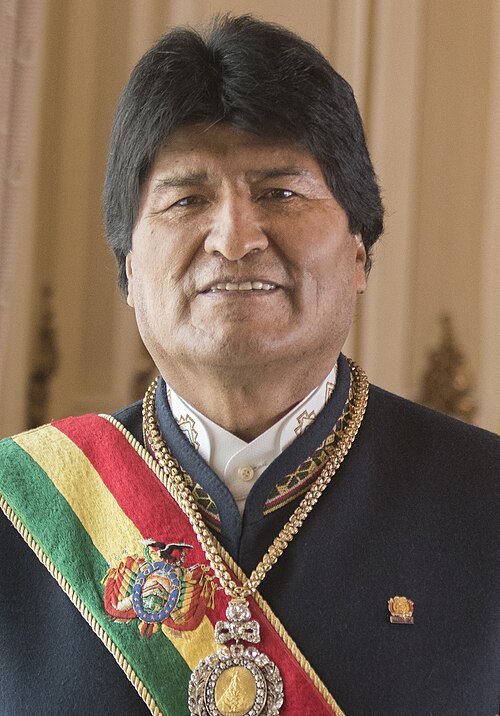
About Evo Morales
Juan Evo Morales Ayma (Spanish: [xwan ˈeβo moˈɾales ˈajma]; born 26 October 1959) is a Bolivian politician, trade union organizer, and cocalero leader who served as the 65th president of Bolivia from 2006 to 2019. He is widely regarded as the country's first president to come from its Indigenous Bolivian population. Ideologically a socialist, he led the Movement for Socialism (MAS) party from 1998 to 2024. Born to an Aymara family of subsistence farmers in Isallawi, Orinoca Canton, Morales had a basic education before undertaking mandatory military service. He then moved to the Chapare in 1978, where he started growing coca and became a trade unionist. He rose to prominence in the union of campesinos (rural laborers). In that capacity, he campaigned against joint U.S.–Bolivian attempts to eradicate coca as part of the war on drugs, denouncing these actions as an imperialist violation of Indigenous Andean culture. His involvement in the anti-government direct action protests resulted in multiple arrests. Morales entered electoral politics in 1995. He was later elected to Congress in 1997 and became leader of MAS in 1998. He campaigned on issues affecting indigenous and poor communities, advocating land reform and more equal redistribution of money from Bolivian gas extraction. He gained increased visibility through the Cochabamba Water War and the Gas War. In 2002, he was expelled from Congress for encouraging anti-government protests, before placing second in that year's presidential election. Once elected president in 2005, his administration implemented left-wing policies, focusing on safeguarding the legal rights and improving the socioeconomic conditions of Bolivia's indigenous majority, and reducing the influence of the United States and multinational corporations. Morales increased taxation on the hydrocarbon industry to bolster social spending and emphasized projects to combat illiteracy, poverty, and racial and gender discrimination. Criticizing neoliberalism, Morales' government moved Bolivia towards a mixed economy, reduced its dependence on the World Bank and International Monetary Fund (IMF), and oversaw strong economic growth, with Bolivia's gross domestic product (GDP) quadrupling between 2006 and 2019. This growth was largely attributed to the nationalization of natural resources, the stability of the exchange rate, the incentive of the domestic market, strong public investment in infrastructure and industrialization of natural resources such as gas and lithium. Bolivia also saw a reduction in poverty, with extreme poverty decreasing from 38.2% to 15.2% between 2006 and 2019 according to the World Bank and ECLAC. The UNDP's 2018 World Human Development Report classified Bolivia as a "high human development Country" for the first time. Scaling back United States influence in the country, he built relationships with leftist governments in the South American pink tide, especially Hugo Chávez's Venezuela and Fidel Castro's Cuba, and signed Bolivia into the ALBA. His administration opposed the autonomist demands of Bolivia's eastern provinces, won a 2008 recall referendum, and instituted a new constitution that established Bolivia as a plurinational state. Re-elected in 2009 and 2014, he oversaw Bolivia's admission to the Bank of the South and CELAC. Morales' popularity was dented by his attempts to abolish presidential term limits and disregard for a referendum rejecting a fourth term. Morales won the disputed 2019 election, but it was widely seen as fraudulent, and he agreed to calls for his resignation amid the ensuing unrest. He fled Bolivia and was granted political asylum in Mexico initially and then Argentina during the presidency of Jeanine Áñez. Morales returned to Bolivia in 2020, following the return of MAS to power upon the election of Luis Arce, his former economic minister. Their relations deteriorated during Arce's term, amid a power struggle for control of the MAS. In the run-up to the 2025 election, Morales was removed from MAS leadership and resigned from the party to form a new one, EVO Pueblo. He ran for president but was barred from participating and called on supporters to cast protest votes; MAS faced a historic defeat while twenty percent of voters invalidated their ballots. Since 2026, Morales faces two arrest warrants for his role in anti-government mass protests and a statutory rape investigation on allegations of inappropriate relationships with minors. Morales' supporters point to his championing of indigenous rights, anti-imperialism, and environmentalism, and credit him with overseeing significant economic growth and poverty reduction as well as increased investment in schools, hospitals, and infrastructure. Critics point to democratic backsliding during his tenure, argue that his policies sometimes failed to reflect his environmentalist and Native American rights rhetoric, and that his defense of coca contributed to illegal cocaine production. Morales won the disputed 2019 election, but amid allegations of electoral fraud and the ensuing unrest, Morales agreed to calls for his resignation. Morales entered electoral politics in 1995, was elected to Congress in 1997 and became leader of MAS in 1998. From 1984 to 1985, Morales served as Secretary of Records for the movement, and in 1985 he became General Secretary of the August Second Headquarters.
Biography source: Wikipedia. The profile adds birthday-specific historical context from the Celebs Birthday Today editorial database.