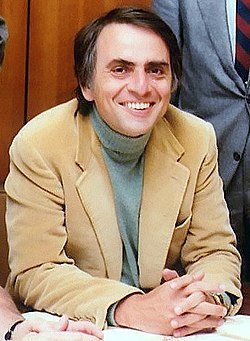
About Carl Sagan
Carl Edward Sagan (SAY-gən; November 9, 1934 – December 20, 1996) was an American astronomer, planetary scientist and science communicator. He played an active role in the Mariner, Viking and Voyager programs. He is widely regarded as one of the most influential science communicators of his generation. Cosmos, the companion volume, was the bestselling science book to date. A lifelong science fiction fan, Sagan entered the genre with Contact, which was adapted as the film of the same name. He was a founding member and first president of the Planetary Society. He proposed the Pale Blue Dot photograph of Earth taken by Voyager 1. He had a lifelong interest in the possibility of extraterrestrial life and is generally credited with contributions to the Arecibo message, with a much more significant role developing the Pioneer plaques and the Voyager Golden Record, universal messages that could potentially be understood by any intelligence that might find them. He promoted skepticism and the scientific method, particularly in his penultimate book The Demon-Haunted World. He popularized a toolkit for critical thinking. He made famous the maxim "Extraordinary claims require extraordinary evidence." The phrase "Billions and billions" was attributed to him, although he never said it; he did use it as the title of his last book. Sagan received numerous awards and honors, including the NASA Distinguished Public Service Medal and the National Academy of Sciences Public Welfare Medal. He married three times and had five children. After developing myelodysplasia, Sagan died of pneumonia at the age of 62 on December 20, 1996.
Biography source: Wikipedia. The profile adds birthday-specific historical context from the Celebs Birthday Today editorial database.