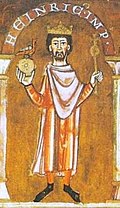
About Henry IV, Holy Roman Emperor
Henry IV (German: Heinrich IV; 11 November 1050 – 7 August 1106) was Holy Roman Emperor (1084–1105), King of Germany (1054–1105), and King of Italy and Burgundy (1056–1105). After his father's death in 1056, his mother acted as regent, granting lands to secure aristocratic support. Unable to control papal elections, she witnessed the growing assertion of the "liberty of the Church", a principle central to the emerging Gregorian Reform. In 1062, Archbishop Anno II of Cologne kidnapped Henry and governed until he came of age in 1065. Seeking to recover royal estates lost during his minority, Henry relied on lower-ranking officials, provoking unrest in Saxony and Thuringia. He suppressed revolts there in 1069 and 1071, but his promotion of commoners alienated the nobility. Insisting on his royal prerogative to appoint bishops and abbots, he became embroiled in what would later be known as the Investiture Controversy, coming into conflict with the papacy; Pope Alexander II excommunicated Henry's advisers in 1073. After crushing a renewed rebellion in Saxony in 1075, Henry adopted an active policy in Italy, alarming Alexander's successor, Gregory VII, who threatened him with excommunication for simony. In 1076, German bishops, encouraged by Henry, declared Gregory's election invalid. Gregory responded by excommunicating Henry and releasing his subjects from allegiance. Facing opposition at home, Henry sought absolution through his penitential "Walk to Canossa" in 1077. Though restored to communion, he confronted a rival king, Rudolf of Rheinfelden. Renewed excommunication in 1080 led Henry's supporters to elect the antipope Clement III. Rudolf's death strengthened Henry's position, although his opponents chose a new antiking, Hermann of Salm; in 1084, Clement crowned Henry emperor in Rome. From 1089 to 1096, Henry campaigned in Italy against his son Conrad II, Matilda of Tuscany, and Welf I of Bavaria. In 1105, his younger son, Henry V, forced his abdication. Attempting to regain power, he fell ill and died in 1106 without absolution. His central role in the Investiture Controversy and the "Walk to Canossa" ensured a profoundly contested legacy.
Biography source: Wikipedia. The profile adds birthday-specific historical context from the Celebs Birthday Today editorial database.