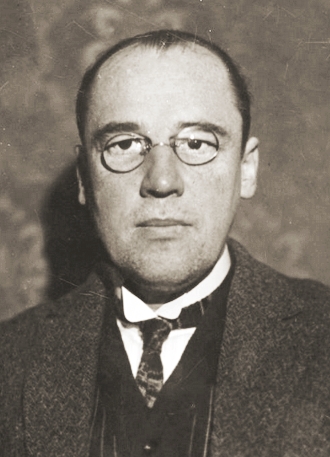
About Wacław Sierpiński
Wacław Franciszek Sierpiński (Polish: [ˈvat͡swaf fraɲˈt͡ɕiʂɛk ɕɛrˈpij̃skʲi]; 14 March 1882 – 21 October 1969) was a Polish mathematician. He was known for contributions to set theory (research on the axiom of choice and the continuum hypothesis), number theory, theory of functions, and topology. He published over 700 papers and 50 books. Three well-known fractals are named after him (the Sierpiński triangle, the Sierpiński carpet, and the Sierpiński curve), as are Sierpiński numbers and the associated Sierpiński problem. Sierpiński was awarded a gold medal for his essay, thus laying the foundation for his first major mathematical contribution. In 1907 Sierpiński first became interested in set theory when he came across a theorem which stated that points in the plane could be specified with a single coordinate. Sierpiński began to study set theory and, in 1909, he gave the first ever lecture course devoted entirely to the subject. He was known for contributions to set theory, number theory, theory of functions, and topology.
Biography source: Wikipedia. The profile adds birthday-specific historical context from the Celebs Birthday Today editorial database.