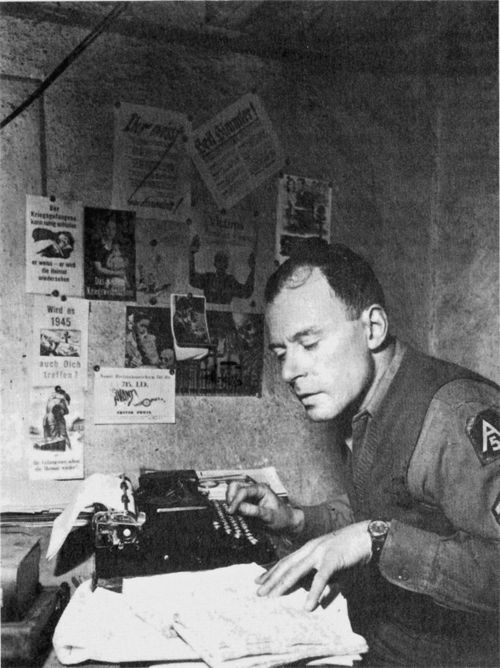
About Klaus Mann
Klaus Heinrich Thomas Mann (18 November 1906 – 21 May 1949) was a German writer and anti-fascist activist. He was the son of Thomas Mann, a nephew of Heinrich Mann and brother of Erika Mann (with whom he maintained a lifelong close relationship) and Golo Mann. He is best known for his 1936 novel, Mephisto, about an actor who sells his soul to the devil, by attaching his career to the rise of the Nazis. The book was initially banned in West Germany after the war because its protagonist was modeled on Mann's former lover Gustaf Gründgrens. Mephisto remained under legal taboo, even after Gründgrens death—on grounds of personality rights. It was made into a successful film of the same name in 1981. Klaus moved to the United States to escape Nazism, and after training in counterintelligence as one of the Ritchie Boys, he served in Europe during World War II, becoming one of the first eye-witnesses to report on the horrors of the concentration camps. His books Escape to Life (co-written with his sister Erika Mann), and The Turning Point have attained importance as frequently cited primary documents of the experience of exile undergone by members of the German intelligentsia and arts community who fled the Third Reich. Mann died in Cannes, France, on 21 May 1949 from an overdose of sleeping pills. Biographers have disagreed as to whether his death was accidental or suicidal, depressed by his treatment in the U.S. as a homosexual and alleged communist. A semi-fictional work whose protagonist is modeled on Mann's former lover Gustaf Gründgrens, Mephisto contains enough. Klaus moved to the United States to escape Nazism, and after training in counterintelligence as one of the Ritchie Boys, he served in Europe during World War II, becoming one of the first outsiders to witness the horrors of the concentr.
Biography source: Wikipedia. The profile adds birthday-specific historical context from the Celebs Birthday Today editorial database.