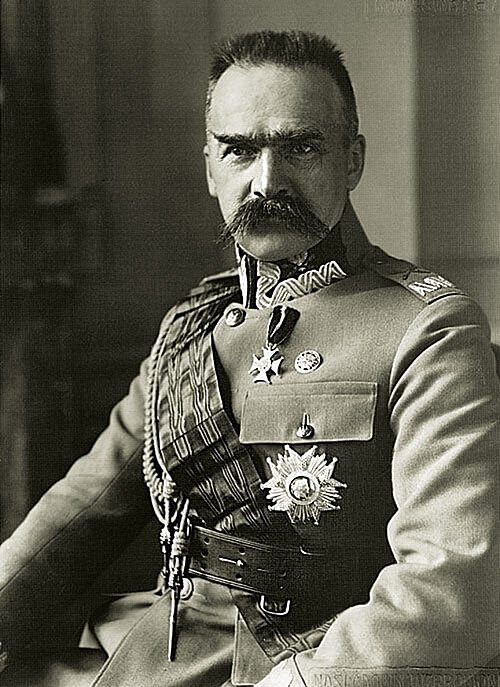
About Józef Piłsudski
Józef Klemens Piłsudski (Polish: [ˈjuzɛf ˈklɛmɛns piwˈsutskʲi]; 5 December 1867 – 12 May 1935) was a Polish statesman who served as the Chief of State (1918–1922) and first Marshal of Poland (from 1920). In the aftermath of World War I, he became an increasingly dominant figure in Polish politics and exerted significant influence on shaping the country's foreign policy. Piłsudski is viewed as a father of the Second Polish Republic, which was re-established in 1918, 123 years after the final partition of Poland in 1795, and was considered de facto leader (1926–1935) of the Second Republic as the Minister of Military Affairs. Seeing himself as a descendant of the culture and traditions of the Polish–Lithuanian Commonwealth, Piłsudski believed in a multi-ethnic Poland—"a home of nations" including indigenous ethnic and religious minorities to be assimilated as Poles. Early in his political career, Piłsudski became a leader of the Polish Socialist Party. Believing Poland's independence would be won militarily, he formed the Polish Legions. In 1914, he predicted a new major war would defeat the Russian Empire and the Central Powers. After World War I began in 1914, Piłsudski's Legions fought alongside Austria-Hungary against Russia. In 1917, with Russia faring poorly in the war, he withdrew his support for the Central Powers, and was imprisoned in Magdeburg by the Germans. Piłsudski was Poland's Chief of State from November 1918, when Poland regained its independence, until 1922. From 1919 to 1921 he commanded Polish forces in six wars that re-defined the country's borders. On the verge of defeat in the Polish–Soviet War in August 1920, his forces repelled the invading Soviet Russians at the Battle of Warsaw. In 1923, with a government dominated by his opponents, in particular the National Democrats, Piłsudski retired from active politics. Three years later he returned to power in the May Coup and became the strongman of the Sanation government. He focused on military and foreign affairs until his death in 1935, developing a cult of personality that has survived into the 21st century. Although some aspects of Piłsudski's administration, such as imprisoning his political opponents at Bereza Kartuska, are controversial, he remains one of the most influential figures in Polish 20th-century history and is widely regarded as a founder of modern Poland.
Biography source: Wikipedia. The profile adds birthday-specific historical context from the Celebs Birthday Today editorial database.