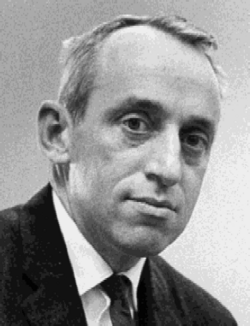
About James Tobin
James Tobin (March 5, 1918 – March 11, 2002) was an American economist who served on the Council of Economic Advisers and consulted with the Board of Governors of the Federal Reserve System, and taught at Yale University. He contributed to the development of key ideas in the Keynesian economics of his generation and advocated government intervention in particular to stabilize output and avoid recessions. His academic work included pioneering contributions to the study of investment, monetary and fiscal policy and financial markets. He also proposed an econometric model for censored dependent variables, the well-known tobit model. Along with fellow neo-Keynesian economist James Meade in 1977, Tobin proposed nominal GDP targeting as a monetary policy rule in 1980. Tobin received the Nobel Memorial Prize in Economic Sciences in 1981 for "creative and extensive work on the analysis of financial markets and their relations to expenditure decisions, employment, production and prices." Outside academia, Tobin was widely known for his suggestion of a tax on foreign exchange transactions, now known as the "Tobin tax." This was designed to reduce speculation in the international currency markets, which he saw as dangerous and unproductive. Tobin was awarded the John Bates Clark Medal in 1955 and, in 1981, the Nobel Memorial Prize in Economics. During his studies he first read Keynes' The General Theory of Employment, Interest and Money, published in 1936. His first published article, in 1941, was based on this senior thesis. Tobin graduated summa cum laude in 1939 with a thesis centered on a critical analysis of Keynes' mechanism for introducing equilibrium involuntary unemployment.
Biography source: Wikipedia. The profile adds birthday-specific historical context from the Celebs Birthday Today editorial database.