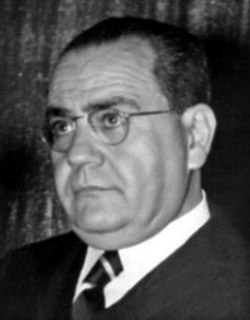
About Juan Negrín
Juan Negrín López (Spanish: [xwan neˈɣɾin]; 3 February 1892 – 12 November 1956) was a Spanish physician and politician who served as prime minister of the Second Spanish Republic. He was a leader of the Spanish Socialist Workers' Party and of the left-leaning Popular Front government during the Spanish Civil War. He also served as minister of finance and minister of defence. He was the last Republican prime minister of Spain (1937–1939), leading the government forces defeated by the Nationalists under General Francisco Franco. He went into exile in Paris, France, where he served as prime minister of the Spanish Republican government in exile until 1945, when he was replaced by José Giral. He died in exile on 12 November 1956. None of the leaders of the Second Spanish Republic has been as vilified as Negrín, not only by Francoist historians but also by important sectors of the exiled Spanish Left. After the end of the civil war there was no person more hated than Negrín. The leaders of his own Socialist Party were among his detractors, including his friend and fellow socialist leader Indalecio Prieto. He has been depicted as primarily responsible for losing the civil war, ruling with a dictatorial style, yielding to Communist influence, and giving Spain's gold reserves to the Soviet Union. Subsequent scholarship has painted a more nuanced picture that clears Negrín of most of these allegations. This work portrays Negrin as mainly a pragmatic, social democratic leader who had no other choice to ally with the Soviets, due to the non-commitment of Great Britain and France to support the democratically elected government against the aggression of Nazi Germany and Fascist Italy. Under the banner "Resistir es vencer" (transl. "To resist is to win"), he tried to keep the Republican cause alive until the outbreak of a world war, which would have granted Republican Spain more allies in Western Europe. The PSOE expelled Negrín in 1946, but he was posthumously rehabilitated in 2008. He was a pupil of Santiago Ramón y Cajal, who won the Nobel Prize of Medicine. Juan was the firstborn son and had one brother Heriberto, who adhered to the Claretian order, and a sister Dolores.
Biography source: Wikipedia. The profile adds birthday-specific historical context from the Celebs Birthday Today editorial database.