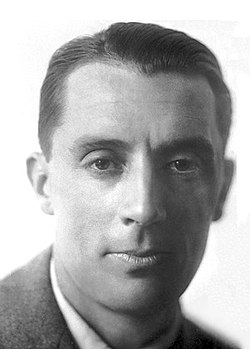
About Frédéric Joliot-Curie
Jean Frédéric Joliot-Curie (French: [fʁedeʁik ʒɔljo kyʁi]; né Joliot; 19 March 1900 – 14 August 1958) was a French chemist and physicist who received the 1935 Nobel Prize in Chemistry with his wife, Irène Joliot-Curie, for their discovery of induced radioactivity. They were the second married couple, after his parents-in-law, to win the Nobel Prize, adding to the Curie family legacy of four Nobel Prizes. Joliot-Curie and his wife also founded the Orsay Faculty of Sciences, part of the Paris-Saclay University. == Biography == === Early years === Born in Paris, France, Frédéric Joliot was a graduate of ESPCI Paris. In 1925 he became an assistant to Marie Curie, at the Radium Institute. He fell in love with her daughter Irène Curie, and soon after their marriage in 1926 they both changed their surnames to Joliot-Curie. At the insistence of Marie, Joliot-Curie obtained a second baccalauréat, a bachelor's degree, and a doctorate in science, doing his thesis on the electrochemistry of radio-elements. === Career === While a lecturer at the Paris Faculty of Science, he collaborated with his wife on research on the structure of the atom, in particular on the projection, or recoil, of nuclei that had been struck by other particles, which was an essential step in the discovery of the neutron by James Chadwick in 1932. In 1935 they were awarded the Nobel Prize in Chemistry for their discovery of Induced radioactivity, resulting from the creation of short-lived radioisotopes by nuclear transmutation from the bombardment of stable nuclides such as boron, magnesium, and aluminium with alpha particles. In 1937, he left the Radium Institute to become a professor at the Collège de France.
Biography source: Wikipedia. The profile adds birthday-specific historical context from the Celebs Birthday Today editorial database.