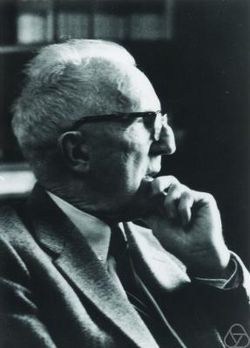
About Marston Morse
Harold Calvin Marston Morse (March 24, 1892 – June 22, 1977) was an American mathematician best known for his work on the calculus of variations in the large, a subject where he introduced the technique of differential topology now known as Morse theory. The Morse–Palais lemma, one of the key results in Morse theory, is named after him, as is the Thue–Morse sequence, an infinite binary sequence with many applications. He was elected to the American Academy of Arts and Sciences in 1929, the United States National Academy of Sciences in 1932, and the American Philosophical Society in 1936. In 1933 he was awarded the Bôcher Memorial Prize for his work in mathematical analysis. J. Robert Oppenheimer described Morse as "almost a statesman of mathematics." == Biography == Morse was born in Waterville, Maine to Ella Phoebe Marston and Howard Calvin Morse in 1892. He received his bachelor's degree from Colby College (also in Waterville) in 1914. At Harvard University, he received both his master's degree in 1915 and his PhD in 1917. He wrote his PhD thesis, Certain Types of Geodesic Motion of a Surface of Negative Curvature, under the direction of George David Birkhoff. Morse was married on June 20, 1922 to Celeste Phelps and they had two children, Meroe and Dryden. The couple divorced.
Biography source: Wikipedia. The profile adds birthday-specific historical context from the Celebs Birthday Today editorial database.