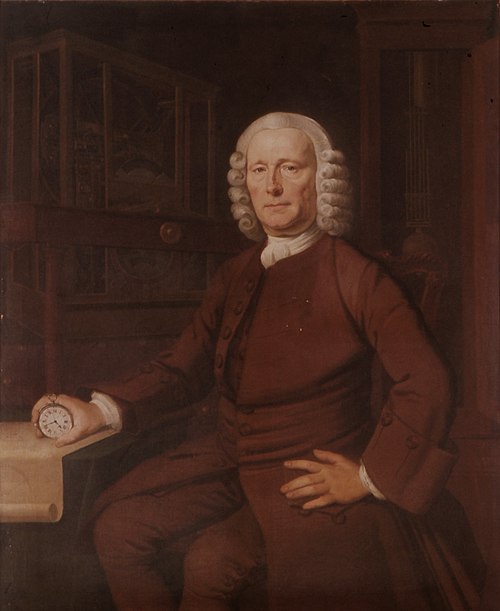
About John Harrison
John Harrison (3 April [O.S. 24 March] 1693 – 24 March 1776) was an English joiner and clockmaker who invented the marine chronometer, a long-sought-after device for solving the problem of how to calculate longitude while at sea. Harrison's solution revolutionized navigation and greatly increased the safety of long-distance sea travel. The problem he solved had been considered so important following the Scilly naval disaster of 1707 that the British Parliament was offering financial rewards of up to £20,000 (equivalent to £3.83 million in 2025) under the 1714 Longitude Act, though Harrison never received the full reward due to political rivalries. He presented his first design in 1730, and worked over many years on improved designs, making several advances in time-keeping technology, finally turning to what were called sea watches. Harrison gained support from the Longitude Board in building and testing his designs. Towards the end of his life, he received recognition and a reward from Parliament. John Harrison (3 April 1693 – 24 March 1776) was an English carpenter and clockmaker who invented the marine chronometer, a long-sought-after device for solving the problem of how to calculate longitude while at sea. Harrison built his first longcase clock in 1713, at the age of 20. Three of Harrison's early wooden clocks have survived: the first (1713) is in the Worshipful Company of Clockmakers' collection, previously in the Guildhall in London and since 2015 on display in the Science Museum.
Biography source: Wikipedia. The profile adds birthday-specific historical context from the Celebs Birthday Today editorial database.