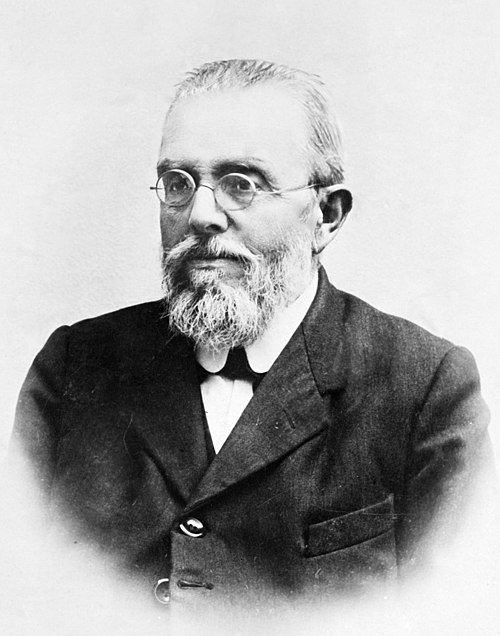
About Giovanni Battista Grassi
Giovanni Battista Grassi (27 March 1854 – 4 May 1925) was an Italian physician and zoologist, best known for his pioneering works on parasitology, especially on malariology. He was Professor of Comparative Zoology at the University of Catania from 1883, and Professor of Comparative Anatomy at Sapienza University of Rome from 1895 until his death. His first major research on the taxonomy and biology of termites earned him the Royal Society's Darwin Medal in 1896. Grassi's scientific contributions covered embryological development of honey bees, on helminth parasites, the vine parasite phylloxera, on migrations and metamorphosis in eels, on arrow worms and termites. He was the first to demonstrate the life cycle of human dwarf tapeworm Taenia nana, and that this tapeworm does not require an intermediate host, contrary to popular belief. He was the first to demonstrate the direct life cycle of the roundworm Ascaris lumbricoides by self-experimentation. He described canine filarial worm Dipetalonema reconditum, and demonstrated the parasite life cycle in fleas, Pulex irritans. He invented the genus of threadworms Strongyloides. He named the spider Koenenia mirabilis in 1885 after his wife, Maria Koenen. He pioneered the foundation of pest control for phylloxera of grapes. The most important contributions of Grassi are on malariology, discovering different species of malarial parasites in birds and humans, and their transmission. With Raimondo Feletti, he discovered Haemamoeba praecox and H. relictum (now under the genus Plasmodium) in birds. They correctly described Haemamoeba malariae and H. vivax (both now under Plasmodium), which became fundamental to clinical distinction of different human malaria: benign tertian caused by P. vivax, malignant tertian by P. falciparum and benign quartan by P. malariae). He was the first to describe and establish the life cycle of the human malarial parasite, Plasmodium falciparum, the most prevalent and deadliest species. He discovered that only female anopheline mosquitoes are capable of transmitting the disease. Grassi's works in malaria remain a lasting controversy in the history of Nobel Prizes. Since the inception of Nobel Prizes in 1901 until his death, he was nominated 21 times. For the 1902 Nobel Prize in Physiology or Medicine, he was nominated alongside French physician Charles Louis Alphonse Laveran, who discovered P. falciparum, and British army surgeon Ronald Ross. He and Ross were shortlisted for the final award, but Ross who appeared to have make the least important discovery, the transmission of malarial parasite in birds, was the sole winner. Grassi, who demonstrated the complete route of transmission of human Plasmodium, and correctly identified the types of malarial parasite as well as the mosquito vector, Anopheles claviger, was denied.
Biography source: Wikipedia. The profile adds birthday-specific historical context from the Celebs Birthday Today editorial database.