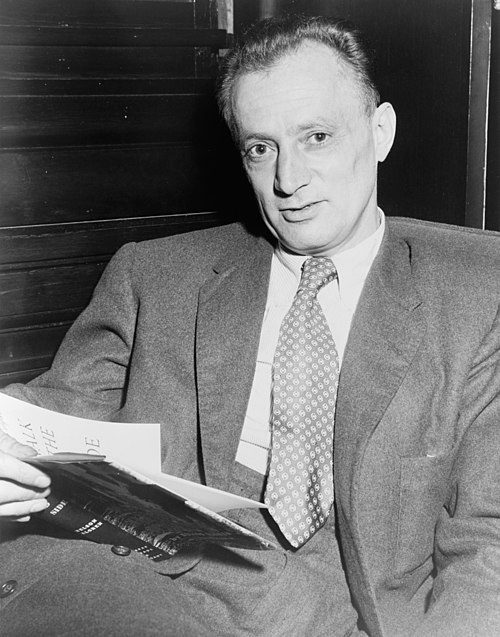
About Nelson Algren
Nelson Algren (born Nelson Ahlgren Abraham; March 28, 1909 – May 9, 1981) was an American writer. His 1949 novel The Man with the Golden Arm won the National Book Award and was adapted as the 1955 film of the same name. Algren articulated the world of "drunks, pimps, prostitutes, freaks, drug addicts, prize fighters, corrupt politicians, and hoodlums". Art Shay singled out a poem Algren wrote from the perspective of a "halfy," street slang for a legless man on wheels. Shay said that Algren considered this poem to be a key to everything he had ever written. The protagonist talks about "how forty wheels rolled over his legs and how he was ready to strap up and give death a wrestle." According to Harold Augenbraum, "in the late 1940s and early 1950s he was one of the best known literary writers in America." A lover of French writer Simone de Beauvoir, he is featured in her novel The Mandarins, set in Paris and Chicago. He was called "a sort of bard of the down-and-outer" based on this book, but also on his short stories in The Neon Wilderness (1947) and his novel A Walk on the Wild Side (1956). The latter was adapted as the 1962 film of the same name (directed by Edward Dmytryk, screenplay by John Fante). Algren wrote his first story, "So Help Me", in 1933, while he was in Texas working at a gas station. His first novel, Somebody in Boots (1935), was later dismissed by Algren as primitive and politically naive, claiming he infused it with Marxist ideas he little understood, because they were fashionable at the time. Algren's first short-story collection, The Neon Wilderness (1947), collected 24 stories from 1933 to 1947.
Biography source: Wikipedia. The profile adds birthday-specific historical context from the Celebs Birthday Today editorial database.