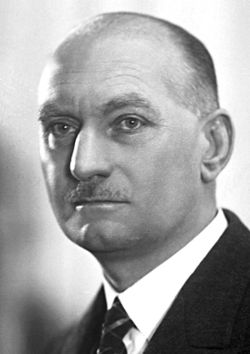
About Corneille Heymans
Corneille Jean François Heymans (28 March 1892 – 18 July 1968) was a Belgian physiologist. He studied at the Jesuit College of Saint Barbara and then at Ghent University, where he obtained a doctor's degree in 1920. Heymans won the Nobel Prize for Physiology or Medicine in 1938 for showing how blood pressure and the oxygen content of the blood are measured by the body and transmitted to the brain. == Early life and education == After graduation Heymans worked at the Collège de France (under Prof. E. Gley), the University of Lausanne (under Prof. M. Arthus), the University of Vienna (under Prof. H. H. Meyer), University College London (under Prof. E. H. Starling) and Case Western Reserve University School of Medicine (under Prof. C. F. Wiggers). In 1922 Heymans became lecturer in Pharmacodynamics at Ghent University, and in 1930 succeeded his father, Jean-François Heymans, as Professor of Pharmacology, as well as being appointed Head of the Department of Pharmacology, Pharmacodynamics, and Toxicology; and Director of the J. F. Heymans Institute.
Biography source: Wikipedia. The profile adds birthday-specific historical context from the Celebs Birthday Today editorial database.