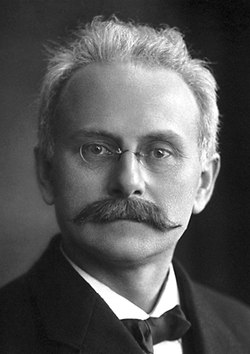
About Johannes Stark
Johannes Stark (German: [joˈhanəs ˈʃtaʁk]; 15 April 1874 – 21 June 1957) was a German physicist who received the Nobel Prize in Physics in 1919 for his discovery of the Stark effect. A supporter of Adolf Hitler from 1924, Stark was one of the main figures, along with fellow Nobel laureate Philipp Lenard, in the antisemitic Deutsche Physik movement, which sought to remove Jewish physicists from German institutions. In 1947, he was found guilty as a "Major Offender" by a denazification court, but this was reduced to "Lesser Offender" in 1949 after appeal. == Education == Johannes Stark was born on 15 April 1874 in Schickenhof (now part of Freihung), Germany. Stark was educated at the Gymnasium in Bayreuth, and later in Regensburg. In 1894, he entered the Ludwig-Maximilians-Universität München, where he studied physics, mathematics, chemistry, and crystallography. In 1897, he received his Ph.D. in Physics with a thesis, written under Eugen von Lommel, titled Untersuchungen über einige physikalische, vorzüglich optische Eigenschaften des Russes (Investigations into some physical, especially optical, properties of soot). Stark stayed at the Ludwig-Maximilians-Universität München as an assistant to von Lommel until 1900. == Career and research == In 1900, Stark became a Privatdozent at the University of Göttingen. In 1906, he was appointed Extraordinary Professor at Königliche Technische Hochschule in Hanover, and in 1909 became Professor at RWTH Aachen University.
Biography source: Wikipedia. The profile adds birthday-specific historical context from the Celebs Birthday Today editorial database.