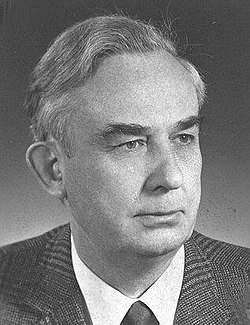
Portrait of Willi Hennig

Birthday profile

Willi Hennig

Willi Hennig, German biologist and entomologist (died 1976)

Born
April 20, 1913
Died
November 5, 1976
Zodiac sign
Taurus
Birth year
1913

About Willi Hennig

Emil Hans Willi Hennig (20 April 1913 – 5 November 1976) was a German biologist and zoologist who is considered the founder of phylogenetic systematics, otherwise known as cladistics. In 1945 as a prisoner of war, Hennig began work on his theory of cladistics, which he published in German in 1950, with a substantially revised English translation published in 1966. With his works on evolution and systematics he revolutionised the view of the natural order of beings. As a taxonomist, he specialised in dipterans (true flies). Hennig coined the key terms synapomorphy, symplesiomorphy, and paraphyly. He also asserted, in his "auxiliary principle", that "the presence of apomorphous (apomorphy) characters in different species 'is always reason for suspecting kinship [i.e., that species belong to a monophyletic group], and that their origin by convergence should not be presumed a priori' (Hennig, 1953). This was based on the conviction that 'phylogenetic systematics would lose all ground on which it stands' if the presence of apomorphous characters in different species were considered first of all as convergences (or parallelisms), with proof to the contrary required in each case." This has been viewed as an application of the parsimony principle to the interpretation of characters, an important component of phylogenetic inference. He is also remembered for Hennig's progression rule in cladistics, which argues controversially that the most primitive species are found in the earliest, central part of a group's area. The Willi Hennig Society, an organization devoted to the advancement of cladistic principles in systematic biology, was founded in 1981. Willi had two brothers, Fritz Rudolf Hennig, who became a minister, and Karl Herbert, who went missing at the Battle of Stalingrad in 1943.

Biography source: Wikipedia. The profile adds birthday-specific historical context from the Celebs Birthday Today editorial database.

Willi Hennig timeline

  1. Willi had two brothers, Fritz Rudolf Hennig, who became a minister, and Karl Herbert, who went missing at the Battle of Stalingrad in 1943.
  2. In 1945 as a prisoner of war, Hennig began work on his theory of cladistics, which he published in German in 1950, with a substantially revised English translation published in 1966.
  3. The Willi Hennig Society, an organization devoted to the advancement of cladistic principles in systematic biology, was founded in 1981.

The world when Willi Hennig was born

Willi Hennig was born in 1913. The year snapshot below places that birthday in its cultural and historical setting: the music and films people were following, the headlines shaping public life, and the everyday prices families encountered.

Culture in 1913

  • Best-selling book"The Inside of the Cup" – Winston Churchill

Headlines and milestones

  • Major sports momentJim Thorpe stripped of Olympic titles over amateurism rules
  • Top headline16th Amendment allows federal income tax
  • Technology milestoneFord assembly line begins — revolutionizes manufacturing
  • World population~1.73B

United States snapshot

  • U.S. leaderWoodrow Wilson
  • U.S. population96.0M

1913 versus 2026

These figures put everyday life in Willi Hennig's birth year beside the site's latest United States snapshot.

Measure19132026
Postage stamp$0.02$0.73
Population96.0M341 million

Sources and editorial standards

This profile combines a biographical source with structured birthday and historical context. Sources recorded for this profile: Wikipedia, Encyclopaedia Britannica, Library of Congress, Wikidata. See our editorial policy for sourcing, corrections, and review standards.

Read the source biography on Wikipedia. Wikipedia text is available under the Creative Commons Attribution-ShareAlike License.