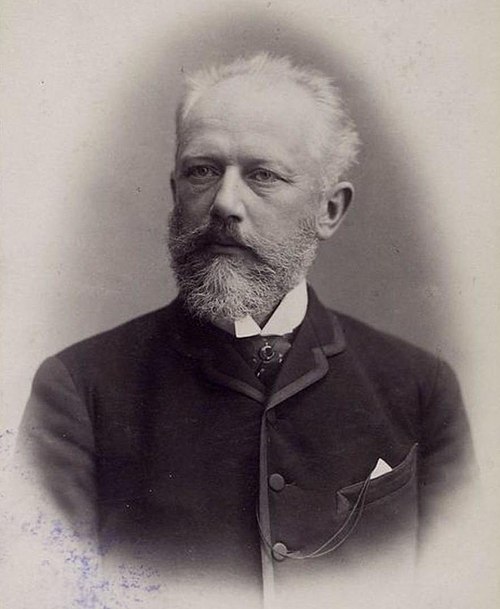
About Pyotr Ilyich Tchaikovsky
Pyotr Ilyich Tchaikovsky ( chy-KOF-skee; 7 May 1840 – 6 November 1893) was a Russian composer of the Romantic period. He was the first Russian composer whose music made a lasting impression internationally. Tchaikovsky wrote some of the most popular concert and theatrical music in the classical repertoire, including the 1812 Overture, his First Piano Concerto, the Violin Concerto, the Romeo and Juliet Overture-Fantasy, several symphonies, the opera Eugene Onegin, and the ballets Swan Lake, The Sleeping Beauty and The Nutcracker. Although musically precocious, Tchaikovsky was educated for a career as a civil servant as there was little opportunity for a musical career in Russia at the time and no public music education system. When an opportunity for such an education arose, he entered the nascent Saint Petersburg Conservatory, from which he graduated in 1865. The formal Western-oriented teaching Tchaikovsky received there set him apart from composers of the contemporary nationalist movement embodied by the Russian composers of The Five, with whom his professional relationship was mixed. Tchaikovsky's training set him on a path to reconcile what he had learned with the native musical practices to which he had been exposed from childhood. From that reconciliation, he forged a personal but unmistakably Russian style. The principles that governed melody, harmony, and other fundamentals of Russian music diverged from those that governed Western European music. There seemed to be little potential for using Russian music in large-scale Western composition or for forming a composite style, and this caused personal antipathies that dented Tchaikovsky's self-confidence. Russian culture exhibited a split personality, with its native and adopted elements having drifted apart increasingly since the time of Peter the Great. That resulted in uncertainty among the intelligentsia about the country's national identity, an ambiguity mirrored in Tchaikovsky's career. Despite his many popular successes, Tchaikovsky's life was punctuated by personal crises and depression. Contributory factors included his early separation from his mother for boarding school followed by her early death, the death of his close friend and colleague Nikolai Rubinstein, his failed marriage to Antonina Miliukova, and the collapse of his 13-year association with the wealthy patroness Nadezhda von Meck. Tchaikovsky's homosexuality, which he kept private, has traditionally also been considered a major factor, though some scholars have downplayed its importance. His dedication of his Sixth symphony to his nephew Vladimir Davydov and the feelings he expressed about Davydov in letters to others have been cited as evidence for romantic love between the two. Tchaikovsky's sudden death at the age of 53 is generally ascribed to cholera, but there is an ongoing debate as to whether cholera was indeed the cause and whether the death was intentional. While his music has remained popular among audiences, critical opinions were initially mixed. Some Russians did not feel it sufficiently represented native musical values and expressed suspicion that Europeans accepted the music for its Western elements. In an apparent reinforcement of that claim, some Europeans lauded Tchaikovsky for offering music more substantive than exoticism, and said he transcended the stereotypes of Russian classical music. Others dismissed Tchaikovsky's music as deficient because it did not stringently follow Western principles. Tchaikovsky's mother, Alexandra Andreyevna (née d'Assier), was the second of Ilya's three wives; his first wife died several years before Pyotr's birth. Tchaikovsky also became attached to Dürbach; her affection for him reportedly counterbalanced his mother's coldness and emotional distance, though others assert that the mother doted on her son. Dürbach saved much of Tchaikovsky's work from this period, including his earliest known compositions, and became a source of several childhood anecdotes.
Biography source: Wikipedia. The profile adds birthday-specific historical context from the Celebs Birthday Today editorial database.