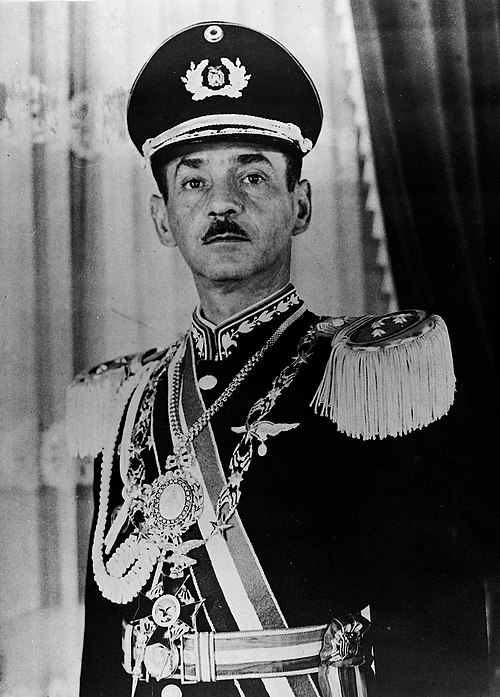
Portrait of Hugo Banzer

Birthday profile

Hugo Banzer

Hugo Banzer, Bolivian general and politician, President of Bolivia (died 2002)

Born
May 10, 1926
Died
May 5, 2002
Zodiac sign
Taurus
Birth year
1926

About Hugo Banzer

Hugo Banzer Suárez (Spanish pronunciation: [ˈuɣo ˈβanseɾ ˈswaɾes]; 10 May 1926 – 5 May 2002) was a Bolivian politician and military officer who served as the 51st president of Bolivia. He held the Bolivian presidency twice: from 1971 to 1978 as a military dictator, and then again from 1997 to 2001, as a democratically elected president. Banzer rose to power via a coup d'état against socialist president Juan José Torres and repressed labor leaders, clergymen, indigenous people, and students during his 1971–1978 dictatorship. Several thousand Bolivians were either forced to seek asylum in foreign countries, arrested, tortured, or killed during this period, known as the Banzerato. After Banzer's removal via a coup led by Juan Pereda, he remained an influential figure in Bolivian politics, and would run for election to the presidency via the ballot box on several occasions, eventually succeeding in 1997 via a narrow plurality of 22.26% of the popular vote. During Banzer's constitutional term, he extended presidential term limits from four years to five, and presided over the Cochabamba Water War, declaring a state of siege in 2000 that suspended several civil liberties and led to violent clashes between demonstrators and law enforcement. After being diagnosed with lung cancer, Banzer resigned in 2001 and was succeeded by Vice President Jorge Quiroga. Among the victims of the regime were Colonel Andrés Selich, Banzer's first Minister of the Interior and co-conspirator in the August 1971 coup. The loans would soon raise Bolivia's external debt to record levels, but proved useful in the manipulation of political patronage. Peru refused to accept the Pinochet proposal and instead created its own counter-proposal, which declared Arica and its waters an area of joint-sovereignty between the three nations. However, massive protests brought the country to a halt, and independent organizations agreed that all exit polls indicated that Siles had actually won handily.

Biography source: Wikipedia. The profile adds birthday-specific historical context from the Celebs Birthday Today editorial database.

Career and life highlights

Hugo Banzer timeline

  1. Among the victims of the regime were Colonel Andrés Selich, Banzer's first Minister of the Interior and co-conspirator in the August 1971 coup.
  2. He held the Bolivian presidency twice: from 1971 to 1978 as a military dictator; and then again from 1997 to 2001, as a democratically elected president.

The world when Hugo Banzer was born

Hugo Banzer was born in 1926. The year snapshot below places that birthday in its cultural and historical setting: the music and films people were following, the headlines shaping public life, and the everyday prices families encountered.

Culture in 1926

  • #1 song"Bye Bye Blackbird"
  • Top movieThe General (Buster Keaton)
  • Best-selling bookThe Sun Also Rises – Ernest Hemingway

Headlines and milestones

  • Major sports momentGertrude Ederle swims the English Channel
  • Top headlineA.A. Milne publishes Winnie-the-Pooh
  • Technology milestoneFirst demonstration of television
  • Defining fadFlagpole sitting
  • Notable inventionPop-up toaster
  • World population2.01 billion

United States snapshot

  • U.S. leaderCalvin Coolidge
  • Sports championSt. Louis Cardinals (World Series)
  • U.S. population117.4M

1926 versus 2026

These figures put everyday life in Hugo Banzer's birth year beside the site's latest United States snapshot.

Measure19262026
Gas$0.23$3.45/gal
Average home$6,000$435,000
Average income$3,620$67,500
Movie ticket$0.25$11.95
Postage stamp$0.02$0.73
Population117.4M341 million

Sources and editorial standards

This profile combines a biographical source with structured birthday and historical context. Sources recorded for this profile: Wikipedia, Encyclopaedia Britannica, Library of Congress, Wikidata. See our editorial policy for sourcing, corrections, and review standards.

Read the source biography on Wikipedia. Wikipedia text is available under the Creative Commons Attribution-ShareAlike License.