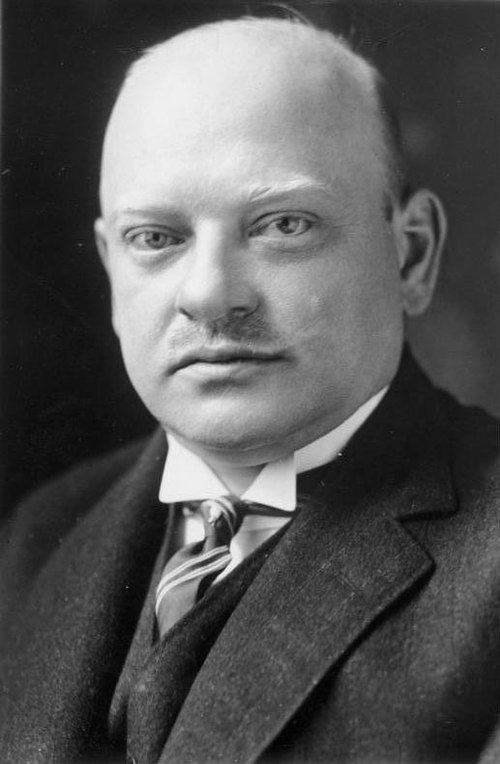
About Gustav Stresemann
Gustav Ernst Stresemann (German pronunciation: [ˈɡʊstaf ˈʃtʁeːzəˌman]; 10 May 1878 – 3 October 1929) was a German statesman during the Weimar Republic who served as chancellor of Germany from August to November 1923 and as foreign minister from 1923 to 1929. His most notable achievement was the reconciliation between Germany and France, for which he and French Prime Minister Aristide Briand received the Nobel Peace Prize in 1926. Stresemann attended the University of Berlin and Leipzig University, where he studied political economy, history and international law and developed his vision of liberalism and nationalism, a combination of views that would define his political career. After obtaining his doctorate, Stresemann worked in trade associations before entering politics. In 1907, he was elected to the Reichstag as a deputy for the National Liberal Party. He lost his seat in 1912 but was re-elected two years later. During World War I, he was a vocal advocate for German militarism and expansionism. Exempted from war service due to poor health, he gradually became the National Liberals' de facto leader before formally taking over the party in 1917. Germany's defeat and the fall of the Hohenzollern monarchy came as a significant shock to Stresemann, forcing him to gradually reassess his previous positions. In August 1923, Stresemann was named chancellor and foreign minister of a grand coalition government. During his brief chancellorship, he abandoned the policy of passive resistance against the French-Belgian occupation of the Ruhr and introduced the Rentenmark in a (relatively successful) attempt to tame hyperinflation in the country. In November, Stresemann's reshuffled government collapsed after the Social Democrats withdrew from the coalition. He resigned as chancellor following a vote of no confidence but remained as foreign minister in the new government led by Wilhelm Marx. His first major diplomatic success was the 1924 Dawes Plan, which reduced Germany's overall reparations commitment. It was followed by the Locarno Treaties in 1925, which confirmed Germany's postwar western borders, guaranteed peace with France, and led to Germany's admission to the League of Nations a year later. Stresemann also moved to improve relations with the Soviet Union through the 1926 Treaty of Berlin. In 1928, he oversaw Germany's participation in the Kellogg–Briand Pact, in which the signatory states promised not to use war to resolve international conflicts. Amid failing health, Stresemann successfully negotiated the Young Plan, which sought to further reduce German reparations payments. He died in October 1929 after a series of strokes at the age of 51.
Biography source: Wikipedia. The profile adds birthday-specific historical context from the Celebs Birthday Today editorial database.