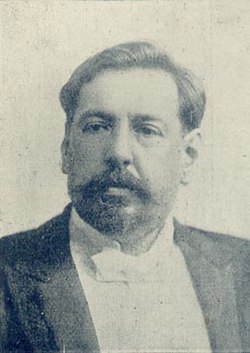
About José Batlle y Ordóñez
José Pablo Torcuato Batlle y Ordóñez ([ˈbaʒe] or [ˈbaʃe]; 23 May 1856 – 20 October 1929), nicknamed Don Pepe, was a prominent Uruguayan politician who served two terms as President of Uruguay for the Colorado Party. The son of a former president, he introduced his political system, Batllism, to South America and modernized Uruguay through his creation of extensive welfare state reforms. In 1898, Batlle served as interim president for a few weeks. He was later elected to the presidency for two terms: from 1903 to 1907 and from 1911 to 1915. He remains one of the most popular Uruguayan presidents, mainly due to his role as a social reformer. Influenced by Krausist liberalism, he is known for influencing the introduction of universal suffrage and the eight-hour workday, as well as free high school education. He was one of the main promoters of Uruguayan secularization, which led to the separation of the state and the Catholic Church. Education started a process of great expansion from the mid-to-late 19th century onward. It became the key to success for the middle class community. The state established free high school education and created more high schools through the country. The University of the Republic was also opened to women, and educational enrollment increased throughout the country. Batlle also "revitalized the Colorado party and strengthened its liberal tradition, giving way to ideas of general and universal interest, and favoring the right of the working class to organize and put forward just demands." Government intervention in the economy increased during Batlle's tenure. Batlle nationalized Montevideo's electric power plant, and BROU (a savings and loan institution that monopolized the printing of money). He established industrial institutes for geology and drilling (coal and hydrocarbon explorations), industrial chemistry, and fisheries. In 1914, the administration purchased the North Tramway and Railway Company, which later became the State Railways Administration of Uruguay. He implemented protectionist policies for industry. Indigenous companies also emerged, although foreign capital (especially from Britain and the United States), as noted by one study, "also took advantage of the legislation and came to control the meat industry. The growth of the frigorífico meat-processing industry also stimulated the interbreeding of livestock, Uruguay's main source of wealth." Batlle believed in government intervention in the economy, and criticized economic inequality. Batlle's grandfather, José Batlle y Carreó, had arrived in Montevideo on his own ship with Batlle's grandmother from Sitges, a town near Barcelona, and built a flour mill which won a contract to provision the Royal Spanish Navy in Montevideo.
Biography source: Wikipedia. The profile adds birthday-specific historical context from the Celebs Birthday Today editorial database.