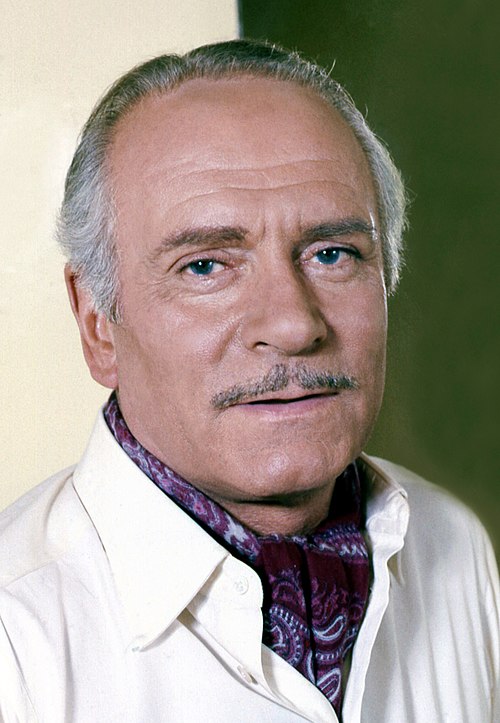
About Laurence Olivier
Laurence Kerr Olivier, Baron Olivier ( ə-LIV-ee-ay; 22 May 1907 – 11 July 1989) was an English actor and director. He and his contemporaries John Gielgud, Michael Redgrave and Ralph Richardson made up a quartet of male actors who dominated the British stage of the mid-20th century. He also worked in films throughout his six-decade career, playing more than fifty cinema roles. Late in his career, Olivier had considerable success in television roles. Olivier's family had no theatrical connections, but his father, a clergyman, decided that his son should become an actor. After attending a drama school in London, Olivier learned his craft in a succession of acting jobs during the late 1920s. In 1930 he had his first important West End success in Noël Coward's Private Lives, and he appeared in his first film. In 1935 he played in a celebrated production of Romeo and Juliet alongside Gielgud and Peggy Ashcroft, and by the end of the decade he was an established star. In the 1940s, together with Richardson and John Burrell, Olivier was the co-director of the Old Vic, building it into a highly respected company. There his most celebrated roles included Shakespeare's Richard III and Sophocles's Oedipus. In the 1950s Olivier was an independent actor-manager, but his stage career had stagnated until he joined the avant-garde English Stage Company in 1957 to play the title role in The Entertainer, a part he later reprised on film. From 1963 to 1973 he was the founding director of Britain's National Theatre, running a resident company that fostered many future stars. His own parts there included the title role in Othello (1965), and Shylock in The Merchant of Venice (1970). Among Olivier's films are Wuthering Heights (1939), Rebecca (1940) and a trilogy of Shakespeare films as actor/director: Henry V (1944), Hamlet (1948) and Richard III (1955). His later films included Spartacus (1960), The Shoes of the Fisherman (1968), Sleuth (1972), Marathon Man (1976) and The Boys from Brazil (1978). His television appearances included an adaptation of The Moon and Sixpence (1960), Long Day's Journey into Night (1973), Love Among the Ruins (1975), Cat on a Hot Tin Roof (1976), A Little Romance (1979), Brideshead Revisited (1981) and King Lear (1983). Olivier's honours included a knighthood (1947), a life peerage (1970) and the Order of Merit (1981). For his on-screen work he received an Academy Award, five British Academy Film Awards, five Emmy Awards and four Golden Globe Awards in addition to nominations for a Tony Award, two British Academy Television Awards and a Grammy Award. Olivier was awarded two non-competitive Academy Honorary Awards in 1947 and 1979, the Golden Globe Cecil B. DeMille Award in 1983 and a BAFTA Fellowship in 1976. The National Theatre's largest auditorium is named in his honour, and he is commemorated in the Laurence Olivier Awards, given annually by the Society of London Theatre. He was married three times: to the actresses Jill Esmond from 1930 to 1940, Vivien Leigh from 1940 to 1960, and Joan Plowright from 1961 until his death in 1989, and had four children. Olivier was awarded with two non-competitive Academy Honorary Awards in 1947 and 1979, the Golden Globe Cecil B. Gerard Olivier had begun a career as a schoolmaster, but in his thirties he discovered a strong religious vocation and was ordained as a priest of the Church of England. This meant a nomadic existence, and for Laurence's first few years, he never lived in one place long enough to make friends.
Biography source: Wikipedia. The profile adds birthday-specific historical context from the Celebs Birthday Today editorial database.