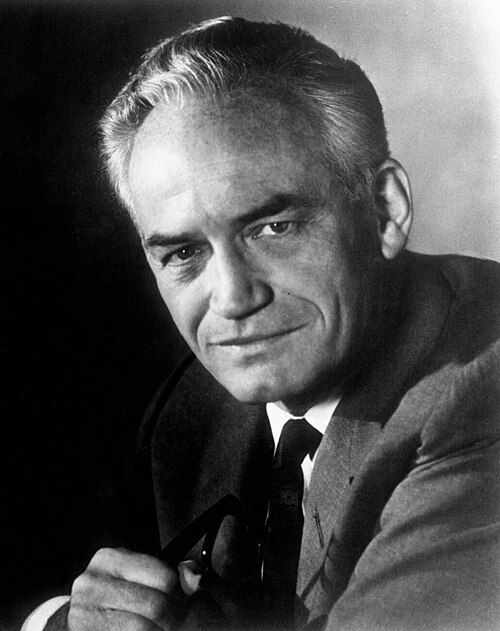
About Barry Goldwater
Barry Morris Goldwater (January 2, 1909 – May 29, 1998) was an American politician and major general in the Air Force Reserve who served as a United States senator from 1953 to 1965 and 1969 to 1987, and was the Republican Party's nominee for president in the 1964 election. Goldwater was born in Phoenix, Arizona, where he helped manage his family's department store. During World War II, he flew aircraft between the U.S. and India. After the war, Goldwater served in the Phoenix City Council. In 1952, he was elected to the U.S. Senate, where he rejected the legacy of the New Deal and, along with the conservative coalition, fought against the New Deal coalition. Goldwater also challenged his party's moderate to liberal wing on policy issues. He supported the Civil Rights Acts of 1957 and 1960 and the 24th Amendment to the U.S. Constitution but opposed the Civil Rights Act of 1964, disagreeing with Title II and Title VII. In the 1964 U.S. presidential election, Goldwater mobilized a large conservative constituency to win the Republican nomination, but then lost the general election to incumbent Democratic president Lyndon B. Johnson in a landslide. Goldwater returned to the Senate in 1969 and specialized in defense and foreign policy. Along with representatives John Jacob Rhodes and Hugh Scott, he successfully urged president Richard Nixon to resign in 1974 when evidence of a cover-up in the Watergate scandal became overwhelming and impeachment was imminent. In 1986, he oversaw passage of the Goldwater–Nichols Act, which strengthened civilian authority in the U.S. Department of Defense. Near the end of his career, Goldwater's views on social and cultural issues grew increasingly libertarian. Many political pundits and historians believe he laid the foundation for the conservative revolution to follow as the grassroots organization and conservative takeover of the Republican Party began a long-term realignment in American politics, which helped to bring about the presidency of Ronald Reagan in the 1980s. He also had a substantial impact on the American libertarian movement. After leaving the Senate, Goldwater became supportive of environmental protection, gay rights, including military service and adoption rights for same-sex couples, abortion rights, and the legalization of marijuana. His father's family founded Goldwater's Department Store, a leading upscale department store in Phoenix. Goldwater remained in the Army Air Reserve after the war, and in 1946, at the rank of Colonel, Goldwater founded the Arizona Air National Guard. The team won every mayoral and council election for the next two decades.
Biography source: Wikipedia. The profile adds birthday-specific historical context from the Celebs Birthday Today editorial database.