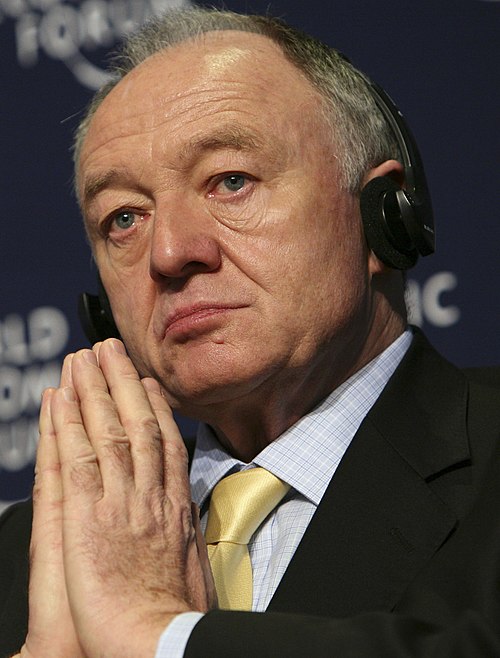
About Ken Livingstone
Kenneth Robert Livingstone (born 17 June 1945) is an English politician who served as the Leader of the Greater London Council (GLC) from 1981 until the council was abolished in 1986, and as the first mayor of London from the creation of the office in 2000 until 2008. He also served as the Member of Parliament (MP) for Brent East from 1987 to 2001. He is a former member of the Labour Party, ideologically identifying as a socialist. Born in Lambeth, South London, to a working-class family, Livingstone joined Labour in 1968 and was elected to represent Norwood on the GLC in 1973, Hackney North and Stoke Newington in 1977, and Paddington in 1981. In the latter year, Labour representatives on the GLC elected him as the council's leader. Attempting to reduce London Underground fares, his plans were challenged in court and declared unlawful; more successful were his schemes to benefit women and several minority groups, despite stiff opposition. The mainstream press gave him the moniker "Red Ken" in reference to his socialist beliefs and criticised him for supporting republicanism, LGBT rights, and a United Ireland. Livingstone was a vocal opponent of the Conservative Party government of Prime Minister Margaret Thatcher, which in 1986 abolished the GLC. Elected as MP for Brent East in 1987, he became closely associated with anti-racist campaigns. He attempted to stand for the position of Labour Party leader following Neil Kinnock's resignation in 1992, but failed to get enough nominations. Livingstone became a vocal critic of Tony Blair's New Labour project that pushed the party closer to the political centre and won the 1997 general election. After failing to become Labour's candidate in the 2000 London mayoral election, Livingstone successfully contested the election as an independent candidate. In his first term as Mayor of London, he introduced the congestion charge, Oyster card, and articulated buses, and unsuccessfully opposed the privatisation of the London Underground's infrastructure. Despite his opposition to Blair's government on issues like the Iraq War, Livingstone was invited to stand for re-election as Labour's candidate. Re-elected in 2004, he expanded his transport policies, introduced new environmental regulations, and enacted civil rights reforms. Overseeing London's winning bid to host the 2012 Summer Olympics and ushering in a major redevelopment of the city's East End, his leadership after the 7 July 2005 London bombings was widely praised. After losing both the 2008 and 2012 London mayoral elections to the Conservative candidate Boris Johnson, Livingstone became a key ally of Labour leader Jeremy Corbyn in 2015. A longstanding critic of Israeli policy regarding Palestinians, his comments about the relationship between Adolf Hitler and Zionism resulted in his 2016 suspension from Labour. He resigned from the party in 2018. One of the most prominent left-wing British politicians of modern times, Livingstone was a controversial and polarising figure. Supporters praised his efforts to improve rights for women, LGBT people, and ethnic minorities in London, but critics emphasised allegations of cronyism and antisemitism, as well as his connections to Irish republicans and Islamist extremists.
Biography source: Wikipedia. The profile adds birthday-specific historical context from the Celebs Birthday Today editorial database.