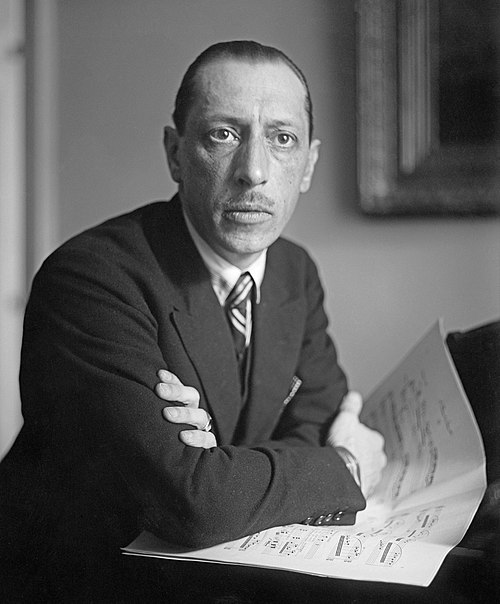
About Igor Stravinsky
Igor Fyodorovich Stravinsky (17 June [O.S. 5 June] 1882 – 6 April 1971) was a Russian composer and conductor with French (from 1934) and American citizenship (from 1945). He is widely considered one of the most important and influential composers of the 20th century and a pivotal figure in modernist music. Born into a musical family in Saint Petersburg, Stravinsky grew up taking piano and music theory lessons. While studying law at the University of Saint Petersburg, he met Nikolai Rimsky-Korsakov and studied music under him until the latter's death in 1908. Soon after, Stravinsky met impresario Sergei Diaghilev, who commissioned him to write three ballets for the Ballets Russes's Paris seasons: The Firebird (1910), Petrushka (1911), and The Rite of Spring (1913), the last of which caused a near-riot at the premiere due to its avant-garde nature and later changed the way composers understood rhythmic structure. Stravinsky's compositional career is often divided into three main periods: his Russian period (1913–1920), his neoclassical period (1920–1951), and his serial period (1954–1968). During his Russian period, Stravinsky was heavily influenced by Russian styles and folklore. Works such as Renard (1916) and Les noces (1923) drew upon Russian folk poetry, while compositions like L'Histoire du soldat (1918) integrated these folk elements with popular musical forms, including the tango, waltz, ragtime, and chorale. His neoclassical period exhibited themes and techniques from the classical period, like the use of the sonata form in his Octet (1923) and use of Greek mythological themes in works including Apollon musagète (1927), Oedipus rex (1927), and Persephone (1935). In his serial period, Stravinsky turned towards compositional techniques from the Second Viennese School like Arnold Schoenberg's twelve-tone technique. In Memoriam Dylan Thomas (1954) was the first of his compositions to be fully based on the technique, and Canticum Sacrum (1956) was his first to be based on a tone row. Stravinsky's last major work was the Requiem Canticles (1966), which was performed at his funeral. While many supporters were confused by Stravinsky's constant stylistic changes, later writers recognized his versatile language as important in the development of modernist music. Stravinsky's revolutionary ideas influenced composers as diverse as Aaron Copland, Philip Glass, Béla Bartók, and Pierre Boulez, who were all challenged to innovate music in areas beyond tonality, especially rhythm and musical form. In 1998, Time magazine listed Stravinsky as one of the 100 most influential people of the century. Stravinsky died of pulmonary edema on 6 April 1971 in New York City, having left six memoirs written with his friend and assistant, Robert Craft, as well as an earlier autobiography and a series of lectures. That year, the dedicatee of the Piano Sonata, Nikolay Richter, performed it at a recital hosted by the Rimsky-Korsakovs, marking the first public premiere of a Stravinsky piece. After Fyodor died in 1902, Stravinsky became more independent and increasingly involved in Rimsky-Korsakov's circle of artists.
Biography source: Wikipedia. The profile adds birthday-specific historical context from the Celebs Birthday Today editorial database.