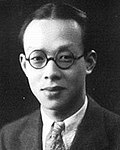
About Zhou Youguang
Zhou Youguang (Chinese: 周有光; pinyin: Zhōu Yǒuguāng, born Zhou Yaoping; 13 January 1906 – 14 January 2017), also known as Chou Yu-kuang or Chou Yao-ping, was a Chinese economist, linguist, sinologist, and supercentenarian. He has been credited as the father of pinyin, the most popular romanization system for Chinese, which was adopted by the People's Republic of China (PRC) in 1958, the International Organization for Standardization (ISO) in 1982, and the United Nations in 1986. == Early life and career == Zhou Yaoping was born in Changzhou, Jiangsu, on 13 January 1906 to a Qing government official. At the age of ten, he and his family moved to Suzhou. In 1918, he entered Changzhou Senior High School, during which time he first took an interest in linguistics. He graduated in 1923 with honors. Zhou enrolled that same year in St. John's University, Shanghai where he majored in economics and took supplementary coursework in linguistics. He was almost unable to attend due to his family's poverty, but friends and relatives raised 200 yuan for the admission fee, and also helped him pay for tuition. He left in 1925 during the May Thirtieth Movement and transferred to Guanghua University, from which he graduated in 1927.
Biography source: Wikipedia. The profile adds birthday-specific historical context from the Celebs Birthday Today editorial database.