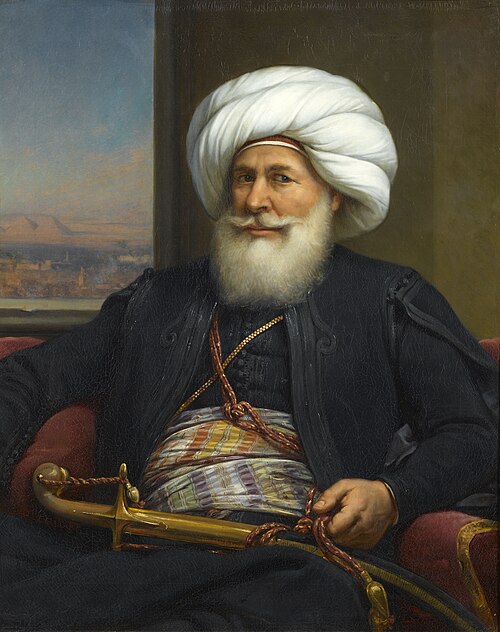
About Muhammad Ali
Muhammad Ali (4 March 1769 – 2 August 1849) was an Ottoman military commander, statesman, and governor who became the de facto ruler of Egypt from 1805 to 1848. He founded the Muhammad Ali dynasty, which ruled Egypt and Sudan for more than a century, and is widely regarded as one of the central figures in the creation of modern Egypt. Muhammad Ali was born in Kavala, then a town of the Ottoman Empire, in 1769. His family's ethnic and geographical origins have been described differently in historical scholarship. A family account written by his son Ibrahim Pasha, cited by the TDV İslâm Ansiklopedisi, states that Muhammad Ali's father, Ibrahim Agha, and grandfather, Osman Agha, had migrated from Konya in central Anatolia to Kavala following a blood feud. On the basis of this tradition and other evidence, Muhammad Ali and his paternal family have been described as being of Anatolian Turkish origin. Other historians have described him as being of Albanian origin. Modern scholarship therefore contains competing accounts of his ancestry, while sources identifying his birthplace as Kavala are well established. Muhammad Ali's cultural and political formation was Ottoman. Turkish was his principal language, and his career began within the Ottoman military and administrative world. In 1801 he travelled to Egypt as part of an Ottoman expeditionary force sent to expel the remaining French forces following Napoleon's campaign. The contingent in which he served included a substantial number of Albanian troops, and Muhammad Ali subsequently became one of the commanders of the Albanian units in Egypt. Amid the political struggle that followed the French withdrawal, he built alliances with local notables, Ottoman soldiers and elements of the Mamluk establishment, eventually securing his appointment as Wāli (governor) of Egypt in 1805. As governor, Muhammad Ali established an increasingly autonomous and effectively hereditary regime while formally remaining a subject of the Ottoman sultan. He reorganised Egypt's army and administration and introduced major economic, educational and industrial reforms. He also destroyed much of the political power of the Mamluk elite, most famously through the 1811 massacre at the Cairo Citadel, consolidating his control over the country. At the height of his power, Muhammad Ali controlled Egypt, Sudan, the Hejaz, much of the Levant, Crete, and other territories, and transformed Egypt into one of the strongest military and political powers in the eastern Mediterranean. His forces reconquered the Arabian territories held by the Emirate of Diriyah, conquered Sudan, and intervened on behalf of Sultan Mahmud II against the Greek revolt. The destruction of the Ottoman-Egyptian fleet at the Battle of Navarino in 1827, however, ended his attempt to suppress the Greek revolution. Muhammad Ali later turned against the Ottoman government. During the Egyptian–Ottoman War (1831–1833), his son Ibrahim Pasha defeated Ottoman armies, occupied Syria, advanced across Anatolia and threatened Constantinople. A second confrontation in 1839 again ended in an Ottoman defeat. European intervention ultimately forced Muhammad Ali to withdraw from most of his conquests, but the Ottoman government recognised the hereditary rule of Egypt by Muhammad Ali and his descendants in 1841. The Muhammad Ali dynasty continued to rule Egypt under various titles until the Egyptian revolution of 1952, when King Farouk was overthrown by the Free Officers Movement. The monarchy was formally abolished the following year. Muhammad Ali (4 March 1769 – 2 August 1849) was the Ottoman viceroy and governor of Albanian origin, who became the de facto ruler of Egypt from 1805 to 1848, widely considered the founder of modern Egypt.
Biography source: Wikipedia. The profile adds birthday-specific historical context from the Celebs Birthday Today editorial database.