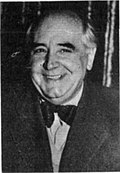
About Miroslav Krleža
Miroslav Krleža (pronounced [mǐroslaʋ kř̩leʒa]; 7 July 1893 – 29 December 1981) was a Croatian writer, widely considered to be the greatest of the 20th century. He wrote notable works in several literary genres, including poetry (The Ballads of Petrica Kerempuh, 1936), theater (Messrs. Glembay, 1929), short story collections (The Croatian God Mars, 1922), novels (The Return of Philip Latinowicz, 1932; On the Edge of Reason, 1938), and an intimate diary. His works often include themes of bourgeois hypocrisy and conformism in Austria-Hungary and the Kingdom of Yugoslavia. Krleža wrote numerous essays on problems of art, history, politics, literature, philosophy, and military strategy, and was known as one of the great polemicists of the century. His style combines visionary poetic language and sarcasm. Krleža dominated the cultural life of Croatia and Yugoslavia for half a century. A "Communist of his own making", he was criticized in Communist circles in the 1930s for his refusal to submit to the tenets of socialist realism. After the Second World War, he held various cultural posts in Socialist Yugoslavia, and was most notably the director of the Yugoslav Lexicographical Institute and a constant advisor on cultural affairs to President Tito. After the break with Stalin, his speech at the 1952 Congress of Yugoslav Writers signaled a new era of comparative freedom in Yugoslav literature. Supported by Tito, in 1950 Krleža founded the Yugoslav Institute for Lexicography, holding the position as its head until his death. He was awarded the Laureate Of The International Botev Prize in 1981.
Biography source: Wikipedia. The profile adds birthday-specific historical context from the Celebs Birthday Today editorial database.