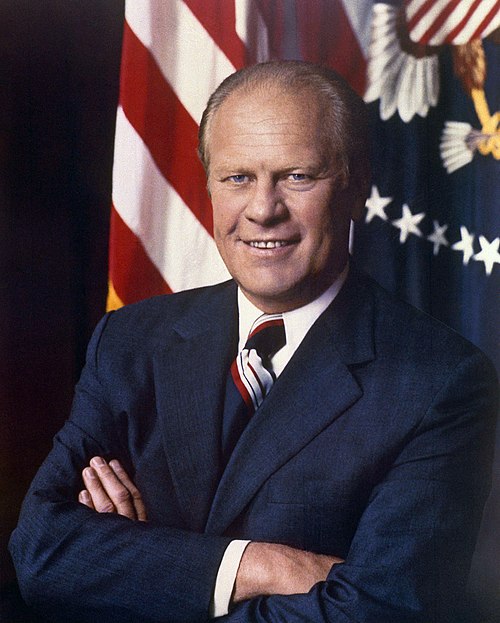
About Gerald Ford
Gerald Rudolph Ford Jr. (born Leslie Lynch King Jr.; July 14, 1913 – December 26, 2006) was the 38th president of the United States, serving from 1974 to 1977. He assumed the presidency after the resignation of Richard Nixon, under whom he served as the 40th vice president from 1973 to 1974, after the resignation of Spiro Agnew. A member of the Republican Party, Ford previously served in the United States House of Representatives from 1949 to 1973. Ford was born in Omaha, Nebraska, and raised in Grand Rapids, Michigan. He attended the University of Michigan, where he played for the university football team, before eventually attending Yale Law School. Afterward, he served in the U.S. Naval Reserve from 1942 to 1946. He was then briefly hired as a business manager for the Grand Rapids Rangers in the Professional Basketball League of America next to head coach Stan Szukala in 1947. Ford was elected to the House of Representatives in 1948 from Michigan's 5th congressional district. He served in this capacity for nearly 25 years, the final nine of them as the House minority leader. During his career in the House, he was also part of the Warren Commission, which investigated the assassination of President John F. Kennedy. In December 1973, two months after the resignation of vice president Agnew, Ford became the first person appointed to the vice presidency under the terms of the 25th Amendment. After President Nixon resigned in August 1974, Ford immediately assumed the presidency. Domestically, Ford presided over the worst economy in the four decades since the Great Depression, with growing inflation and a recession. His presidency was also overshadowed by the Watergate Scandal. In one of his most controversial acts, he granted a presidential pardon to Nixon for his role in the Watergate scandal. Foreign policy was characterized in procedural terms by the increased role Congress began to play, and by the corresponding curb on the powers of the president. Ford signed the Helsinki Accords, which marked a move toward détente in the Cold War. With the collapse of South Vietnam eight months into his presidency, U.S. involvement in the Vietnam War essentially ended. In the 1976 Republican presidential primary, he narrowly defeated Ronald Reagan for the Republican nomination, but narrowly lost the general election to the Democratic candidate, Jimmy Carter. Ford remains the only person to serve as president without winning a presidential election for president or vice president. After leaving office in 1977, Ford remained active in the Republican Party, but his moderate views on various social issues increasingly put him at odds with conservative members of the party in the 1990s and early 2000s. He also set aside the enmity he had felt towards Carter following the 1976 presidential election and the two former presidents developed a close friendship. After experiencing a series of health problems, he died at his home in Rancho Mirage, California, in 2006. Surveys of historians and political scientists have ranked Ford as a below-average president, though retrospective public polls on his time in office were more positive. Ford later told confidants that his father had first hit his mother when she had smiled at another man during their honeymoon. In his senior year of 1934, the team suffered a steep decline and won only one game, but Ford was still the team's star player. In one of those games, Michigan held heavily favored Minnesota—the eventual national champion—to a scoreless tie in the first half. A member of the Republican Party, Ford assumed the presidency after the resignation of Richard Nixon, under whom he had served as the 40th vice president from 1973 to 1974 following the resignation of Spiro Agnew.
Biography source: Wikipedia. The profile adds birthday-specific historical context from the Celebs Birthday Today editorial database.