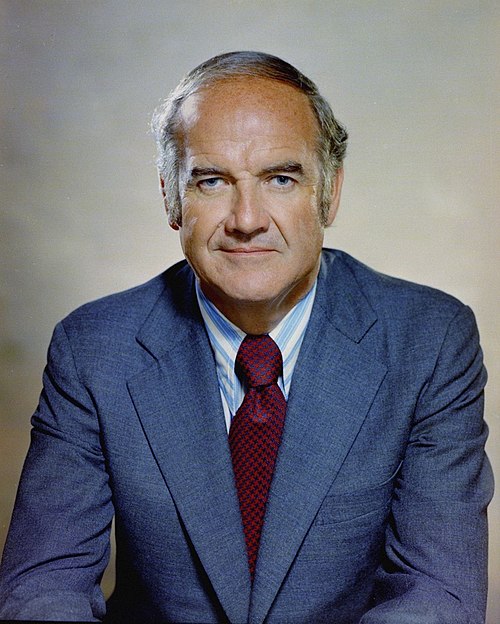
About George McGovern
George Stanley McGovern (July 19, 1922 – October 21, 2012) was an American politician, diplomat, and historian from South Dakota who served in both chambers of the United States Congress, first as a member of the United States House of Representatives representing South Dakota's 1st congressional district from 1957 to 1961, and then as a United States Senator from 1963 to 1981. McGovern also served as the director of Food for Peace in 1961 and 1962 under President John F. Kennedy. A member of the Democratic Party, he was the party's presidential nominee in the 1972 presidential election. McGovern was born in Avon, South Dakota, and grew up in the near city of Mitchell, where he became a renowned debater. He volunteered for the U.S. Army Air Forces upon the country's entry into World War II. As a B-24 Liberator pilot, he flew 35 missions over German-occupied Europe from a base in Italy. Among the medals he received was a Distinguished Flying Cross for making a hazardous emergency landing of his damaged plane and saving his crew. After the war, he earned degrees from Dakota Wesleyan University and Northwestern University, culminating in a PhD, and served as a history professor. He was elected to the U.S. House of Representatives in 1956 and re-elected in 1958. After a failed bid for the U.S. Senate in 1960, he was a successful candidate in 1962. As a senator, McGovern was a prominent example of modern American liberalism. He became most known for his outspoken opposition to the growing U.S. involvement in the Vietnam War. He staged a brief nomination run in the 1968 presidential election as a stand-in for the assassinated Robert F. Kennedy. The subsequent McGovern–Fraser Commission fundamentally altered the presidential nominating process, by increasing the number of caucuses and primaries and reducing the influence of party insiders. The McGovern–Hatfield Amendment sought to end the Vietnam War by legislative means but was defeated in 1970 and 1971. McGovern's long-shot, grassroots-based 1972 presidential campaign found triumph in gaining the Democratic nomination but left the party split ideologically, and the failed vice-presidential pick of Thomas Eagleton undermined McGovern's credibility. In the general election, McGovern lost to incumbent President Richard Nixon in one of the biggest landslides in U.S. electoral history. Although re-elected to the Senate in 1968 and 1974, McGovern was defeated in his bid for a fourth term in 1980. Beginning with his experiences in war-torn Italy and continuing throughout his career, McGovern was involved in issues related to agriculture, food, nutrition, and hunger. As the first director of the Food for Peace program in 1961, McGovern oversaw the distribution of U.S. surpluses to the needy abroad and was instrumental in the creation of the United Nations-run World Food Programme. As sole chairman of the Senate Select Committee on Nutrition and Human Needs from 1968 to 1977, McGovern publicized the problem of hunger within the United States and issued the "McGovern Report", which led to a new set of nutritional guidelines for Americans. McGovern later served as U.S. ambassador to the United Nations Agencies for Food and Agriculture from 1998 to 2001 and was appointed the first UN global ambassador on world hunger by the World Food Programme in 2001. The McGovern–Dole International Food for Education and Child Nutrition Program has provided school meals for millions of children in dozens of countries since 2000 and resulted in McGovern's being named World Food Prize co‑laureate in 2008. He died at the age of 90 in October 2012.
Biography source: Wikipedia. The profile adds birthday-specific historical context from the Celebs Birthday Today editorial database.