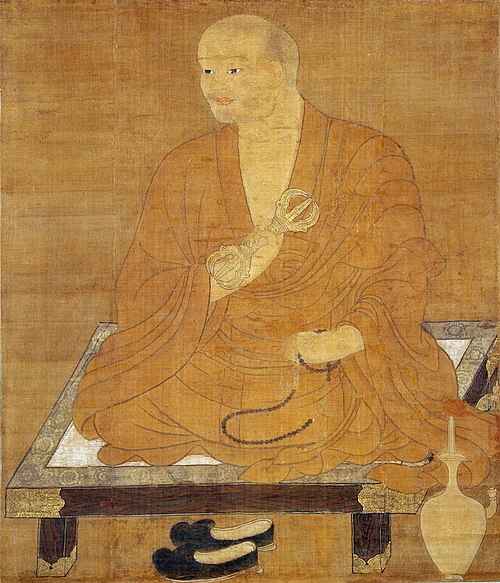
About Kūkai
Kūkai (空海; Japanese pronunciation: [kɯꜜː.kai], 27 July 774 – 22 April 835), born Saeki no Mao (佐伯 眞魚) posthumously called Kōbō Daishi (弘法 大師; [koː.boː daꜜi.ɕi], lit. 'the Grand Master Who Propagated the Dharma'), was a Japanese Buddhist monk, calligrapher, and poet who founded the esoteric Shingon school of Buddhism. He travelled to China, where he studied Tangmi (Chinese Vajrayana Buddhism) under the monk Huiguo. Mount Kōya was chosen by him as a holy site, and he spent his later years there until his death in 835 CE. Because of his importance in Japanese Buddhism, Kūkai is associated with many stories and legends. One such legend attributes the invention of the kana syllabary to Kūkai, with which the Japanese language is written to this day (in combination with kanji), as well as the Iroha poem, which helped to standardise and popularise kana. Shingon followers usually refer to Kūkai by the honorific title of Odaishi-sama (お大師様; "The Grand Master"), and the religious name of Henjō Kongō (遍照金剛; "Vajra Shining in All Directions").
Biography source: Wikipedia. The profile adds birthday-specific historical context from the Celebs Birthday Today editorial database.