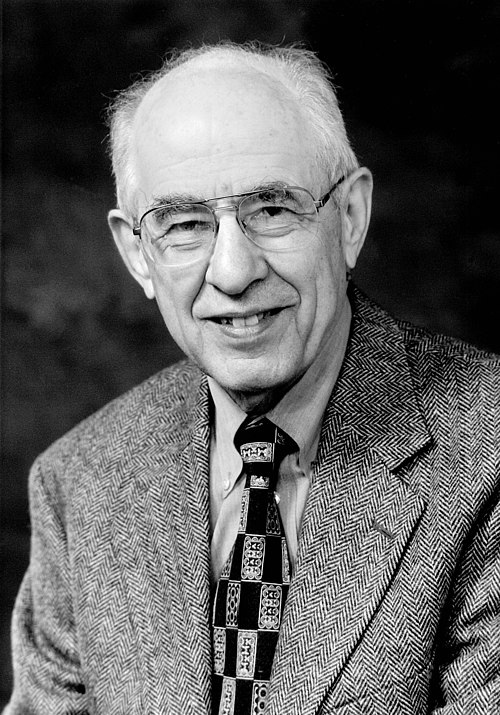
About Hilary Putnam
Hilary Whitehall Putnam (July 31, 1926 – March 13, 2016) was an American philosopher, mathematician, computer scientist, and figure in analytic philosophy in the second half of the 20th century. He contributed to the studies of philosophy of mind, philosophy of language, philosophy of mathematics, and philosophy of science. Together with Martin Davis he developed the Davis–Putnam algorithm for the Boolean satisfiability problem and he helped demonstrate the unsolvability of Hilbert's tenth problem. Putnam applied equal scrutiny to his own philosophical positions as to those of others, subjecting each position to rigorous analysis until he exposed its flaws. As a result, he acquired a reputation for frequently changing his positions. In philosophy of mind, Putnam argued against the type-identity of mental and physical states based on his hypothesis of the multiple realizability of the mental, and for the concept of functionalism, an influential theory regarding the mind–body problem. Putnam also originated the computational theory of mind. In philosophy of language, along with Saul Kripke and others, he developed the causal theory of reference, and formulated an original theory of meaning, introducing the notion of semantic externalism based on a thought experiment called Twin Earth. In philosophy of mathematics, Putnam and W. V. O. Quine developed the Quine–Putnam indispensability argument, an argument for the reality of mathematical entities, later espousing the view that mathematics is not purely logical, but "quasi-empirical". In epistemology, Putnam criticized the "brain in a vat" thought experiment, which appears to provide a powerful argument for epistemological skepticism, by challenging its coherence. Despite these changes of view, throughout his career Putnam remained committed to scientific realism, roughly the view that mature scientific theories are approximately true descriptions of ways things are. He also displayed an interest in metaphilosophy, seeking to "renew philosophy" from what he identified as narrow and inflated concerns. He was at times a politically controversial figure, especially for his involvement with the Progressive Labor Party in the late 1960s and early 1970s. In a 2015 autobiographical essay, Putnam said that his first childhood memories were from his life in France, and his first language was French. Putnam completed the first two years of his primary education in France before he and his parents returned to the U.S. in 1933, settling in Philadelphia.
Biography source: Wikipedia. The profile adds birthday-specific historical context from the Celebs Birthday Today editorial database.