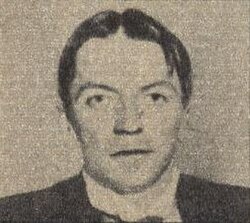
About Kaj Munk
Kaj Harald Leininger Munk (commonly called Kaj Munk; 13 January 1898 – 4 January 1944) was a Danish playwright and Lutheran pastor, known for his cultural engagement and his martyrdom during the occupation of Denmark of World War II. He is commemorated as a martyr in the Calendar of Saints of the Lutheran Church on 14 August, alongside Maximilian Kolbe. == Biography == He was born Kaj Harald Leininger Petersen on the island of Lolland, Denmark, and raised by a family named Munk after the death of his parents. From 1924 until his death, Munk was the vicar in the small village of Vedersø in Western Jutland. Munk's plays were mostly performed and made public during the 1930s, although many were written in the 1920s. Much of his other work concerns the "philosophy-on-life debate" (religion—Marxism—Darwinism) which marked much of Danish cultural life during this period. On one occasion, in the early 1930s, in a comment that came back to haunt him in later years, Munk expressed admiration for Hitler (for uniting Germans) and wished a similar unifying figure for Danes. However, Munk's attitude towards Hitler (and Mussolini) turned to outspoken criticism as he witnessed Hitler's persecution of the German Jewish community, and Mussolini's conduct of the war in Ethiopia. In 1938, the Danish newspaper Jyllands-Posten published on its front page an open letter to Benito Mussolini written by Kaj Munk criticising the persecutions against Jews. Early on, Munk was a strong opponent of the German Occupation of Denmark (1940–1945), although he continually opposed the idea of democracy as such, preferring the idea of a "Nordic dictator" who should unite the Nordic countries and keep them neutral during periods of international crisis. His plays Han sidder ved Smeltediglen ("He sits by the melting pot") and Niels Ebbesen were direct attacks on Nazism.
Biography source: Wikipedia. The profile adds birthday-specific historical context from the Celebs Birthday Today editorial database.