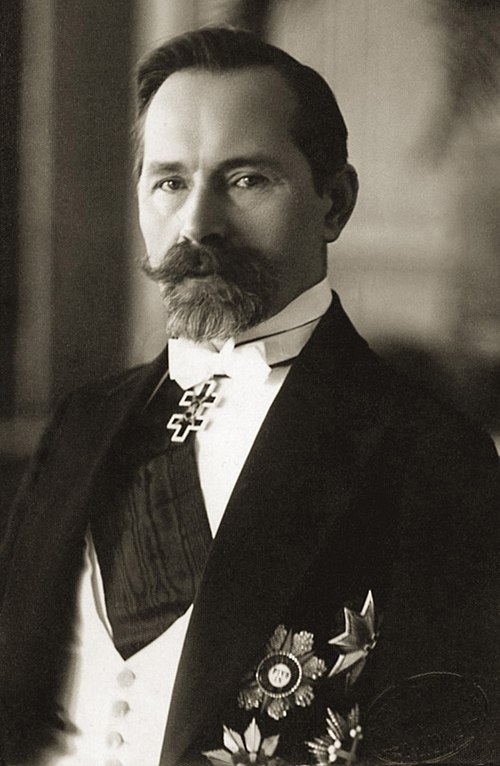
About Antanas Smetona
Antanas Smetona (Lithuanian: [ɐnˈtǎːnɐs sʲmʲɛtoːˈnɐ]; 10 August 1874 – 9 January 1944) was a Lithuanian intellectual, journalist, and politician. He served as the first president of Lithuania from 1919 to 1920 and later as the authoritarian head of state from 1926 until the Soviet occupation of Lithuania in 1940. Referred to as the "Leader of the Nation" during his presidency, Smetona is recognised as one of the most important Lithuanian political figures between World War I and World War II, and a prominent ideologist of Lithuanian nationalism and the movement for national revival. Born into a farming family in the village of Užulėnis, Kovno Governorate, Smetona exhibited a strong interest in education and Lithuanian cultural identity from an early age. He attended Palanga Progymnasium and later graduated from Jelgava Gymnasium. He pursued higher education at the Saint Petersburg Imperial University, where he studied law and became involved in nationalist and cultural movements. During this time, he contributed to the Lithuanian press, advocating for national self-determination and the preservation of Lithuanian culture under Russian imperial rule. After completing his studies, he worked as a teacher and journalist, eventually becoming one of the key intellectual leaders of the Lithuanian National Revival. The Russian Revolution of 1917 and the subsequent collapse of the Russian Empire provided a pivotal opportunity for Smetona and other Lithuanian leaders to pursue national independence. As a member of the Council of Lithuania, he was instrumental in the drafting and signing of the Act of Independence on 16 February 1918, which proclaimed the restoration of an independent Lithuania. During the interwar period, Smetona emerged as a prominent political figure, serving as the first President and later taking power in a coup d'état in 1926. Under his leadership, Lithuania pursued a policy of neutrality and underwent significant economic and cultural development, despite the challenges posed by regional instability and the rise of authoritarian regimes in Europe. After the Soviet Union occupied Lithuania in 1940, Smetona fled to Germany and later to the United States, where he lived in exile until his death in Cleveland, Ohio, in 1944. His legacy remains a topic of debate among historians. While some view him as a pivotal figure in the establishment of Lithuanian independence and the promotion of national identity, others criticize his authoritarian rule and suppression of political opposition. It was the first time Smetona had visited the city, the historical capital of the Grand Duchy of Lithuania, and it left a deep impression on him.
Biography source: Wikipedia. The profile adds birthday-specific historical context from the Celebs Birthday Today editorial database.