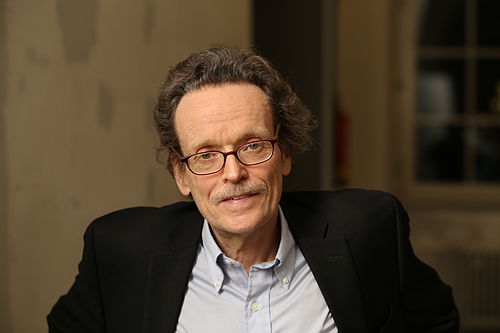
About Thomas Pogge
Thomas Winfried Menko Pogge (; born 13 August 1953) is a German philosopher and is the Director of the Global Justice Program and Leitner Professor of Philosophy and International Affairs at Yale University, United States. In addition to his Yale appointment, he is the Research Director of the Centre for the Study of the Mind in Nature at the University of Oslo, Norway, a Professorial Research Fellow at the Centre for Applied Philosophy and Public Ethics at Charles Sturt University, Australia, and Professor of Political Philosophy at the University of Central Lancashire's Centre for Professional Ethics, England. Pogge is also a member of the Norwegian Academy of Science and Letters. == Early career == Pogge received his PhD from Harvard University in 1983. His dissertation, titled Kant, Rawls, and Global Justice, was supervised by John Rawls. == Major works == Pogge has published widely on Immanuel Kant, and in moral and political philosophy, including various books and articles on Rawls, global justice, and the duties of the global rich in relation to the global poor. === Realizing Rawls (1989) === In Realizing Rawls, Pogge defends, criticizes and extends John Rawls's A Theory of Justice (1971). Pogge insists that Rawls has been importantly misunderstood by his most influential critics, including the libertarian Robert Nozick and the communitarian Michael Sandel. According to Pogge, Rawls' reluctance to disagree sharply with his critics has helped these (mis)understandings to become widespread, and has also induced Rawls in his more recent work to dilute the moral statement of his central Rawlsian ideas: first, that moral deliberation must begin from reflection upon the justice of our basic social institutions; and second, that the justice of an institutional scheme is to be assessed by how well its least advantaged participants fare. From these starting points, Pogge develops his own specification of Rawls's principles of justice, discussing the relative importance of different fundamental rights and liberties, the ideal constitution of the political process, and the just organization of educational, health-care, and economic institutions.
Biography source: Wikipedia. The profile adds birthday-specific historical context from the Celebs Birthday Today editorial database.