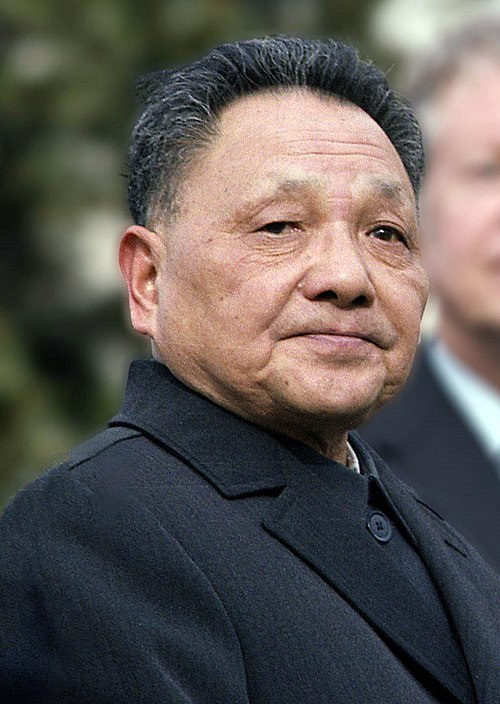
About Deng Xiaoping
Deng Xiaoping (22 August 1904 – 19 February 1997) was a Chinese statesman, revolutionary, and political theorist who served as the paramount leader of the People's Republic of China (PRC) from 1978 to 1989. Emerging as China's most influential figure after Mao Zedong's death in 1976, Deng consolidated political power and guided the country into an era of reform and opening up that transitioned the nation toward a socialist market economy. Credited as the Architect of Modern China, he is recognized for shaping both socialism with Chinese characteristics and Deng Xiaoping Theory. Born into a landowning peasant family in Sichuan, Deng was introduced to Marxism–Leninism while studying and working in France during the 1920s as part of the Work–Study Movement. He then studied in Moscow and, after returning to China, joined the Chinese Communist Party (CCP) in 1924. During the Chinese Civil War, he worked in the Jiangxi Soviet and maintained close ties with Mao. Deng later served as a political commissar in the Chinese Red Army during the Long March and Second Sino-Japanese War, helping secure CCP victory in 1949 and taking part in the People's Liberation Army (PLA) capture of Nanjing. Following Mao's founding of the PRC, Deng rose to prominence as the vice premier of China and CCP secretary-general, overseeing economic reconstruction and playing a leading role in the Anti-Rightist Campaign. Ιn the mid-1960's, economic policy initiatives and the proclamation of the Four Modernizations marked the peak of Deng's Mao-era influence. However, during the Cultural Revolution, he was denounced as the party's "number two capitalist roader" after Liu Shaoqi and was twice purged by Mao, spending four years working in a tractor factory before returning to politics. After Mao's death in 1976, Deng outmaneuvered political rivals and became China's paramount leader by 1978. Upon coming to power, Deng began a massive overhaul of China's infrastructure and political system. Due to institutional disorder and turmoil from the Mao era, he and allies launched the Boluan Fanzheng program which sought to restore order by rehabilitating those persecuted during the Cultural Revolution. His reform and opening up policies introduced market incentives, established special economic zones, encouraged foreign investment, and accelerated China's integration into the global economy. Deng also pursued major state reforms, including constitutional term limits (enshrined in the 1982 Constitution of China), the one-child policy to address population growth, a nine-year compulsory education system, and promotion of technology through the 863 Program. These changes shifted China away from a command economy and Maoist orthodoxy, laying the foundation for decades of rapid economic growth. Furthermore, as the overseer of Beijing's foreign policy, Deng negotiated the handover of Hong Kong and handover of Macau and formulated the guiding principle of "one country, two systems". Deng received worldwide acclaim and was named Time Person of the Year in 1978 and 1985 for his policies and reforms. Despite contributions to China's modernization, Deng's legacy is also marked by controversy. He ordered the crackdown on the 1989 Tiananmen Square protests, which halted his political reforms and remains a subject of international condemnation. Nonetheless, Deng's policies facilitated China's rise to become one of the world's great powers. He was succeeded by Jiang Zemin, who continued his reform agenda. When Deng first attended school, his tutor objected to him having the given name Xiansheng, instead calling him "Xixian" (希贤), which includes the characters "to aspire to" and "goodness", with overtones of wisdom. Deng, the youngest of all the Chinese students in the group, had just turned 15.
Biography source: Wikipedia. The profile adds birthday-specific historical context from the Celebs Birthday Today editorial database.