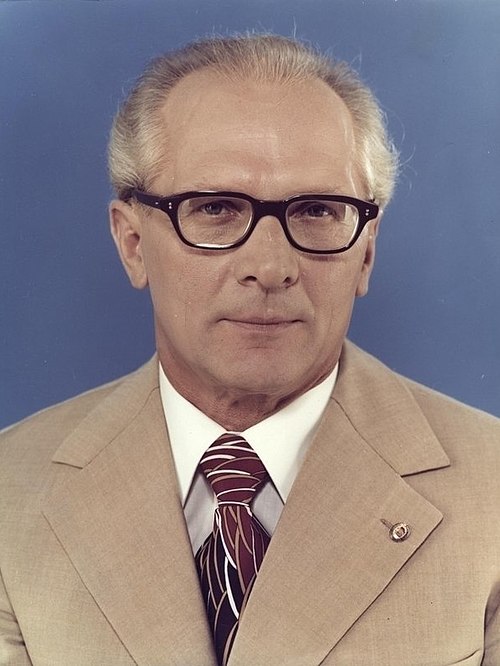
About Erich Honecker
Erich Ernst Paul Honecker (German: [ˈeːʁɪç ˈhɔnɛkɐ]; 25 August 1912 – 29 May 1994) was a German communist politician who led the German Democratic Republic (East Germany) from 1971 until shortly before the fall of the Berlin Wall in November 1989. He held the posts of General Secretary of the Socialist Unity Party of Germany (SED) and Chairman of the National Defence Council; in 1976, he replaced Willi Stoph as Chairman of the State Council, the official head of state. As the leader of East Germany, Honecker was viewed as a dictator. During his leadership, the country had close ties to the Soviet Union, which maintained a large army in the country. Honecker's political career began in the 1930s when he became an official of the Communist Party of Germany, a position for which he was imprisoned by the Nazis. Following World War II, he was freed by the Soviet army and relaunched his political activities, founding the SED's youth organisation, the Free German Youth, in 1946 and serving as the group's chairman until 1955. As the Security Secretary of the SED Central Committee, he was the prime organiser of the building of the Berlin Wall in 1961 and, in this function, bore administrative responsibility for the "order to fire" along the Wall and the larger inner German border. In 1970, Honecker initiated a political power struggle that led, with support of Soviet leader Leonid Brezhnev, to him replacing Walter Ulbricht as General Secretary of the SED and chairman of the National Defence Council. Under his command, the country adopted a programme of "consumer socialism" and moved towards the international community by normalising relations with West Germany and also becoming a full member of the UN, in what is considered one of his greatest political successes. As Cold War tensions eased in the late 1980s with the advent of perestroika and glasnost—the liberal reforms introduced by Soviet leader Mikhail Gorbachev—Honecker refused all but cosmetic changes to the East German political system. He cited the consistent hardliner attitudes of Kim Il Sung, Fidel Castro and Nicolae Ceaușescu whose respective governments of North Korea, Cuba and Romania had been critical of reforms. Honecker was forced to resign by the SED Politburo in October 1989 in a bid to improve the government's image in the eyes of the public; the effort was unsuccessful, and the regime would collapse entirely the following month. Following German reunification in 1990, Honecker sought asylum in the Chilean embassy in Moscow, but was extradited back to Germany in 1992, after the fall of the Soviet Union, to stand trial for his role in the human rights abuses committed by the East German government. However, the proceedings were abandoned, as Honecker was suffering from terminal liver cancer. He was freed from custody to join his family in exile in Chile, where he died in May 1994. In 1946, Honecker became the co-founder of the Free German Youth (FDJ), whose chairmanship he also undertook. After the formation of the SED, the Socialist Unity Party, in April 1946 through a merger of the KPD and SPD, Honecker swiftly became a leading party member and took his place in the party's Central Committee.
Biography source: Wikipedia. The profile adds birthday-specific historical context from the Celebs Birthday Today editorial database.