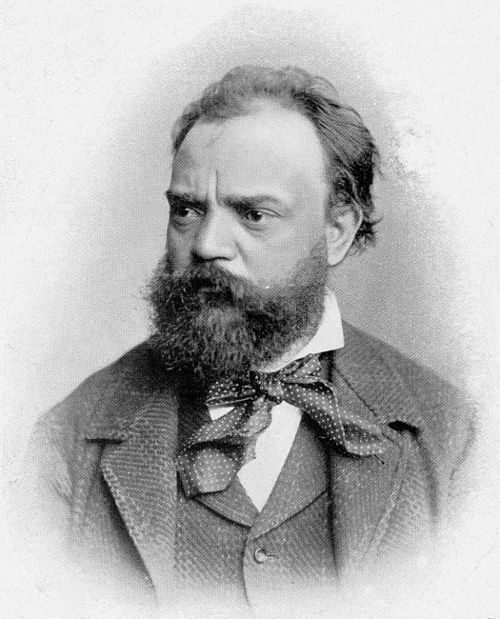
About Antonín Dvořák
Antonín Leopold Dvořák (8 September 1841 – 1 May 1904) was a Czech composer. He frequently employed rhythms and other aspects of the folk music of Moravia and his native Bohemia, following the Romantic era nationalist example of his predecessor Bedřich Smetana. Dvořák's style has been described as "the fullest recreation of a national idiom with that of the symphonic tradition, absorbing folk influences and finding effective ways of using them", and Dvořák has been described as "arguably the most versatile... composer of his time". Dvořák displayed his musical gifts at an early age, being a talented violin student. The first public performances of his works were in Prague in 1872 and, with special success, in 1873, when he was 31 years old. Seeking recognition beyond the Prague area, he submitted scores of works including symphonies to competitions in Germany and Austria. He first won a prize in 1874, with Johannes Brahms on the jury of the Austrian State Competition. In 1877, after his third win, Brahms recommended Dvořák to his publisher, Simrock, who commissioned what became the Slavonic Dances, Op. 46. The sheet music's high sales and critical reception led to his international success. A London performance of Dvořák's Stabat Mater in 1883 led to many other performances in the United Kingdom, the United States, and eventually Russia in March 1890. The Seventh Symphony was written for London in 1885. In 1892, Dvořák became the director of the National Conservatory of Music of America in New York City. While in the United States, Dvořák wrote his two most successful orchestral works: the Symphony From the New World, which spread his reputation worldwide, and his Cello Concerto, one of the most highly regarded of all cello concerti. On a summer holiday in Spillville, Iowa, in 1893, Dvořák also wrote his most famous piece of chamber music, his twelfth String Quartet in F major, Op. 96, the American. While he remained at the Conservatory for a few more years, pay cuts and an onset of homesickness led him to return to Bohemia in 1895. All of Dvořák's ten operas, except his first, have librettos in Czech and were intended to convey the Czech national spirit, as were some of his choral works. By far the most successful of the operas is Rusalka, premiered in 1901. Among his smaller works, the seventh Humoresque and the song "Songs My Mother Taught Me" are also widely performed and recorded. The Dvořák Prague International Music Festival is a major series of concerts held annually to celebrate Dvořák's life and works.
Biography source: Wikipedia. The profile adds birthday-specific historical context from the Celebs Birthday Today editorial database.