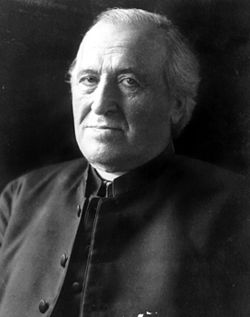
About John Ireland (bishop)
John Ireland (baptized September 11, 1838 – September 25, 1918) was an Irish-American prelate who was the third Catholic bishop and first archbishop of Saint Paul, Minnesota (1888–1918). He became both a religious as well as civic leader in Saint Paul during the turn of the 20th century. Ireland was known for his progressive stance on education, immigration and relations between church and state, as well as his opposition to saloons, alcoholism, political machines, and political corruption. He promoted the Americanization of Catholicism, especially through imposing the English only movement on Catholic parishes by force, a private war against the Eastern Catholic Churches, seeking to make Catholic schools identical to public schools through the Poughkeepsie plan, and through other progressive social ideas. He was widely considered the primary leader of the modernizing element in the Catholic Church in the United States during the Progressive Era, which brought him into open conflict over minority language rights and theology with both his suffragan Bishop Otto Zardetti and eventually with Pope Leo XIII, whose Apostolic letter Testem benevolentiae nostrae condemned Archbishop Ireland's ideas as the heresy of Americanism. He also created or helped to create many religious and educational institutions in Minnesota. One year later Joseph Crétin, first bishop of Saint Paul, sent Ireland to the preparatory seminary of Meximieux in France.
Biography source: Wikipedia. The profile adds birthday-specific historical context from the Celebs Birthday Today editorial database.