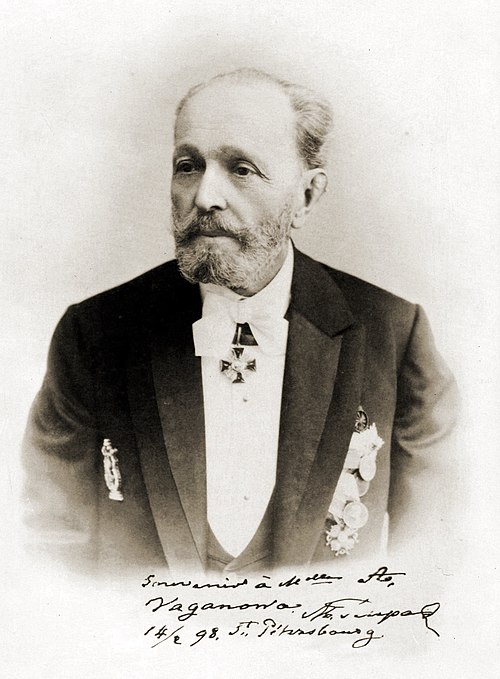
About Marius Petipa
Marius Ivanovich Petipa (Russian: Мариус Иванович Петипа; born Victor Marius Alphonse Petipa; 11 March 1818 – 14 July [O.S. 1 July] 1910) was a French and Russian ballet dancer, pedagogue and choreographer. He is considered one of the most influential ballet masters and choreographers in ballet history. Petipa is noted for his long career as Premier maître de ballet (First Ballet Master) of the St. Petersburg Imperial Theatres, making him Ballet Master and principal choreographer of the Imperial Ballet (today known as the Mariinsky Ballet), a position he held from 1871 until 1903. Petipa created over fifty ballets, some of which have survived in versions either faithful to, inspired by, or reconstructed from his originals. He is most noted for The Pharaoh's Daughter (1862); Don Quixote (1869); La Bayadère (1877); Le Talisman (1889); The Sleeping Beauty (1890); The Nutcracker (choreographed jointly with Lev Ivanov) (1892); Le Réveil de Flore (1894); La Halte de cavalerie (1896); Raymonda (1898); Les Saisons (1900), and Les Millions d'Arlequin (a.k.a. Harlequinade) (1900). Petipa also revived a substantial number of works created by other choreographers. Many of his revivals have become the basis of the majority of subsequent productions of those works. The most famous of Petipa's revivals are Le Corsaire, Giselle, La Esmeralda, Coppélia, La Fille Mal Gardée (with Lev Ivanov), The Little Humpbacked Horse and Swan Lake (with Lev Ivanov). Many individual numbers taken from Petipa's work (both from original works and from revivals) continued to be performed independently, in spite of the fact that the full-length ballets that spawned them had disappeared from the Imperial Ballet's repertoire. Many of these pieces have endured in versions either based on the original or choreographed anew by others – the Grand Pas classique, Pas de trois and Mazurka des enfants from Paquita; Le Carnaval de Venise Pas de deux; The Talisman Pas de deux; La Esmeralda Pas de deux; the Diana and Actéon Pas de deux; La Halte de Cavalerie Pas de deux; the Don Quixote Pas de deux; La Fille Mal Gardée Pas de deux; and the Harlequinade Pas de deux. At the age of nine Marius performed for the first time in a ballet production as a Savoyard in his father's staging of Pierre Gardel's 1800 ballet La Dansomanie in 1827.
Biography source: Wikipedia. The profile adds birthday-specific historical context from the Celebs Birthday Today editorial database.