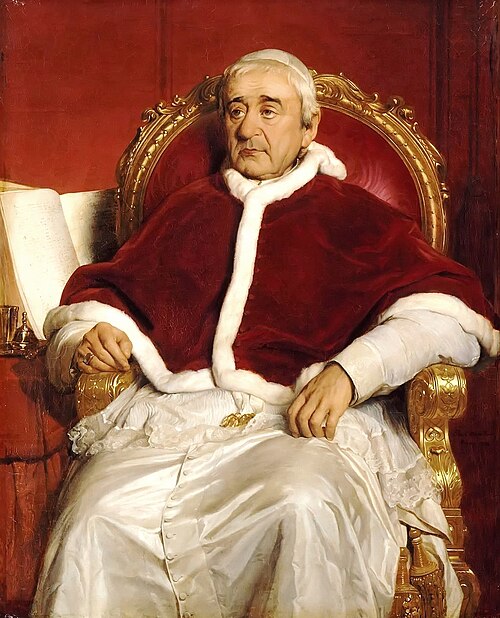
About Pope Gregory XVI
Pope Gregory XVI (Latin: Gregorius PP. XVI; Italian: Gregorio XVI; born Bartolomeo Alberto Cappellari; 18 September 1765 – 1 June 1846) was head of the Catholic Church and leader of the Papal States from 2 February 1831 to his death in June 1846. He had adopted the name Mauro upon entering the religious order of the Camaldolese. Born in Belluno, Cappellari joined the order of Camaldolese when he was eighteen. Ordained as a priest in 1787, he was a teacher of both philosophy and theology. Cappellari was made a cardinal, and, in 1831, he was elected as pope, taking the papal name Gregory XVI. A staunch defender of traditional doctrine against new ideas, he worked to protect the Papal States from attacks by Italian patriotic movements. His pontificate saw a renewed commitment to missionary work overseas. In his 1839 papal brief In supremo apostolatus, Pope Gregory XVI condemned both the slave trade and the continuance of the institution of slavery. He died of erysipelas in June 1846. In 1800, he became a member of the Academy of the Catholic Religion, founded by Pope Pius VII (1800–1823), to which he contributed memoirs on theological and philosophical questions.
Biography source: Wikipedia. The profile adds birthday-specific historical context from the Celebs Birthday Today editorial database.