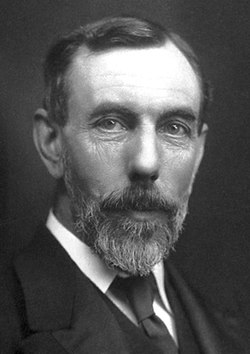
About William Ramsay
Sir William Ramsay (; 2 October 1852 – 23 July 1916) was a Scottish chemist who discovered the noble gases and received the Nobel Prize in Chemistry in 1904 "in recognition of his services in the discovery of the inert gaseous elements in air" along with his collaborator, John William Strutt, 3rd Baron Rayleigh, who received the Nobel Prize in Physics that same year for their discovery of argon. After the two men identified argon, Ramsay investigated other atmospheric gases. His work in isolating argon, helium, neon, krypton, and xenon led to the development of a new section of the periodic table. == Early life == Ramsay was born at 2 Clifton Street in Glasgow on 2 October 1852, the son of civil engineer and surveyor, William C. Ramsay, and his wife, Catherine Robertson. The family lived at 2 Clifton Street in the city centre, a three-storey and basement Georgian townhouse. The family moved to 1 Oakvale Place in the Hillhead district in his youth. He was a nephew of the geologist Sir Andrew Ramsay. He was educated at Glasgow Academy and then apprenticed to Robert Napier, a shipbuilder in Govan. However, he instead decided to study chemistry at the University of Glasgow, matriculating in 1866 and graduating in 1869. He then undertook practical training with the chemist Thomas Anderson and then went to study in Germany at the University of Tübingen with Wilhelm Rudolph Fittig where his doctoral thesis was entitled Investigations in the Toluic and Nitrotoluic Acids.
Biography source: Wikipedia. The profile adds birthday-specific historical context from the Celebs Birthday Today editorial database.