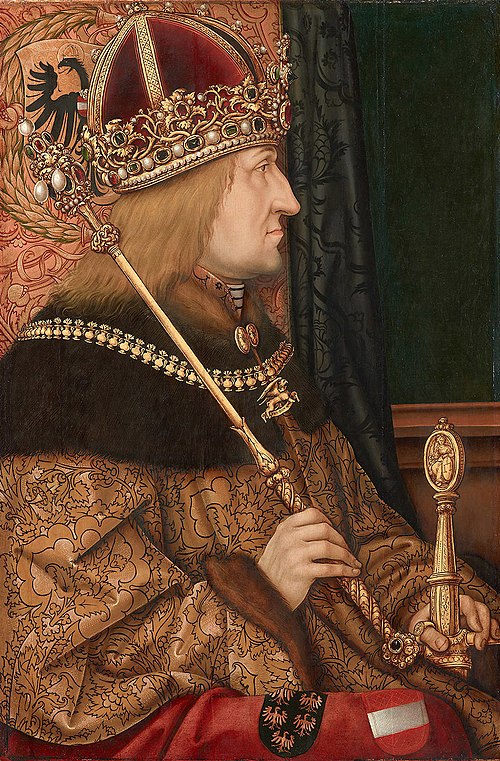
About Frederick III, Holy Roman Emperor
Frederick III, Holy Roman Emperor (German: Friedrich III, 21 September 1415 – 19 August 1493) was Holy Roman emperor from 1452 until his death in 1493. Prior to his imperial coronation, he was duke of the Inner Austrian lands of Styria, Carinthia, and Carniola from 1424, and also acted as regent over the Duchy of Austria from 1439. He was elected and crowned King of Germany in 1440. His reign of 41 years is the longest in the history of the Holy Roman Empire or the German monarchy. Upon his death in 1493, he was succeeded by his son Maximilian I, Holy Roman Emperor. During his reign, Frederick concentrated on re-uniting the Habsburg "hereditary lands" of Austria and took a lesser interest in Imperial affairs. Nevertheless, by his dynastic entitlement to Hungary as well as by the Burgundian inheritance, he laid the foundations for the later Habsburg Empire. Despite being mocked as "Arch-Sleepyhead of the Holy Roman Empire" (German: Erzschlafmütze) during his lifetime, he is today increasingly seen as an effective ruler. Historian Thomas A. Brady Jr. credited Frederick with leaving a credible claim on the imperial title and a secure grip on the Austrian lands, now organised as a single state, for his son. This imperial revival (as well as the rise of the territorial state) began under the reign of Frederick. Frederick III was crowned Holy Roman Emperor in 1452, the first since the death of Emperor Sigismund. Finally, in 1435, Albert V, duke of Austria (later Albert II, the king of Germany), awarded him the rule over his Inner Austrian heritage. As a cousin of late King Albert II, Frederick became a candidate for the 1440 imperial election.
Biography source: Wikipedia. The profile adds birthday-specific historical context from the Celebs Birthday Today editorial database.