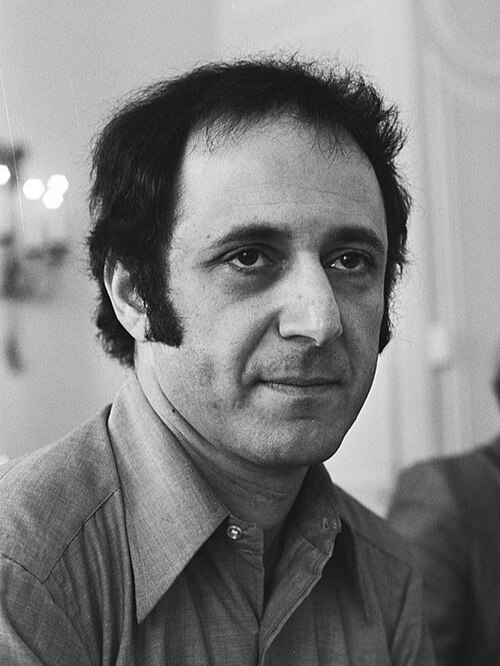
About Steve Reich
Stephen Michael Reich ( RYSHE; born October 3, 1936) is an American composer best known as a pioneer of minimal music in the mid to late 1960s. Reich's work is marked by its use of repetitive figures, slow harmonic rhythm, and canons. Reich describes this concept in his essay "Music as a Gradual Process" by stating, "I am interested in perceptible processes. I want to be able to hear the process happening throughout the sounding music." For example, his early works experiment with phase shifting, in which one or more repeated phrases plays slower or faster than the others, causing it to go "out of phase." This creates new musical patterns in a perceptible flow. His innovations include using tape loops to create phasing patterns, as on the early compositions It's Gonna Rain (1965) and Come Out (1966), and the use of simple, audible processes, as on Pendulum Music (1968) and Four Organs (1970). Works like Drumming (1971) and Music for 18 Musicians (1976), both considered landmarks of minimalism and important influences on experimental music, rock, and contemporary electronic music, would help entrench minimalism as a movement. Reich's work took on a darker character in the 1980s with the introduction of historical themes as well as themes from his Jewish heritage, notably Different Trains (1988). Reich's style of composition has influenced many contemporary composers and groups, especially in the United States and Great Britain. The critic Andrew Clements has suggested that Reich is one of "a handful of living composers who can legitimately claim to have altered the direction of musical history". The soundtrack of Plastic Haircut, composed in 1963, was a short tape collage, possibly Reich's first. Reich adopted this approach to compose his first major work, It's Gonna Rain. The music for Thick Pucker arose from street recordings Reich made walking around San Francisco with Nelson, who filmed in black and white 16mm. A fourth film from 1965, about 25 minutes long and tentatively entitled "Thick Pucker II", was assembled by Nelson from outtakes of that shoot and more of the raw audio Reich had recorded.
Biography source: Wikipedia. The profile adds birthday-specific historical context from the Celebs Birthday Today editorial database.