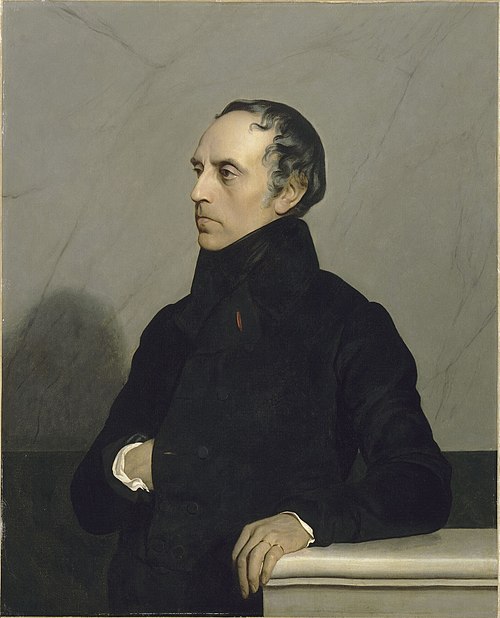
About François Guizot
François Pierre Guillaume Guizot (French: [fʁɑ̃swa pjɛʁ ɡijom ɡizo]; 4 October 1787 – 12 September 1874) was a French historian, orator and statesman. Guizot was a dominant figure in French politics between the Revolution of 1830 and the Revolution of 1848. A conservative liberal who opposed the attempt by King Charles X to usurp legislative power, he worked to sustain a constitutional monarchy following the July Revolution of 1830. He then served the "citizen king" Louis Philippe I, as Minister of Education 1832–37, ambassador to London 1840, Foreign Minister 1840–1847, and finally Prime Minister of France from 19 September 1847 to 23 February 1848. Guizot's influence was critical in expanding public education, which under his ministry saw the creation of primary schools in every French commune. As a leader of the "Doctrinaires", committed to supporting the policies of Louis Phillipe and limitations on further expansion of the political franchise, he earned the hatred of more left-leaning liberals and republicans through his unswerving support for restricting suffrage to propertied men and supposedly advised those who wanted the vote to "enrich yourselves" (enrichissez-vous) through hard work and thrift. As Prime Minister, it was Guizot's ban on the political meetings (called the campagne des banquets or the Paris Banquets, which were held by moderate liberals who wanted a larger extension of the franchise) of an increasingly vigorous opposition in January 1848 that catalyzed the revolution that toppled Louis Philippe in February and saw the establishment of the French Second Republic. He is mentioned in the famous opening paragraph of the Communist Manifesto ("a spectre is haunting Europe...") as a representative of the more liberal faction of the counter-revolutionary forces of Old Europe, contrasted with that of the more reactionary forces, Klemens von Metternich. Marx and Engels published that book just days before Guizot's overthrow in the 1848 Revolution. It was discovered that François Guizot had substituted for her. François Guizot and historian François Mignet invented the concept of the bourgeois revolution. In October 1809, aged twenty-two, he wrote a series review of François-René de Chateaubriand's Martyrs, which won Chateaubriand's approbation and thanks, and he continued to contribute largely to the periodical press.
Biography source: Wikipedia. The profile adds birthday-specific historical context from the Celebs Birthday Today editorial database.