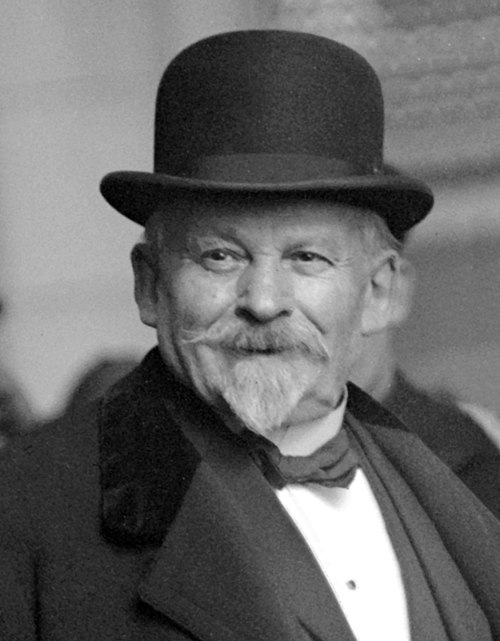
About Émile Coué
Émile Coué de la Châtaigneraie (French: [emil kue də la ʃɑtɛɲʁɛ]; 26 February 1857 – 2 July 1926) was a French psychologist, pharmacist, and hypnotist who introduced a popular method of psychotherapy and self-improvement based on optimistic autosuggestion. It was in no small measure [Coué's] wholehearted devotion to a self-imposed task that enabled him, in less than a quarter of a century, to rise from obscurity to the position of the world’s most famous psychological exponent. Indeed, one might truly say that Coué sidetracked inefficient hypnotism [mistakenly based upon supposed operator dominance over a subject], and paved the way for the efficient, and truly scientific. Coué’s method was disarmingly non-complex—needing few instructions for on-going competence, based on rational principles, easily understood, demanding no intellectual sophistication, simply explained, simply taught, performed in private, using a subject's own resources, requiring no elaborate preparation, and no expenditure. Most of us are so accustomed … to an elaborate medical ritual … in the treatment of our ills … [that] anything so simple as Coué's autosuggestion is inclined to arouse misgivings, antagonism and a feeling of scepticism. Coué's method was based upon the view that, operating deep below our conscious awareness, a complex arrangement of 'ideas' (especially when those ideas are dominant), continuously and spontaneously suggest things to us and significantly influence one's overall health and wellbeing. We possess within us a force of incalculable power, which, when we handle it unconsciously is often prejudicial to us. If on the contrary we direct it in a conscious and wise manner, it gives us the mastery of ourselves and allows us not only to escape … from physical and mental ills, but also to live in relative happiness, whatever the conditions in which we may find ourselves. As long as we look on autosuggestion as a remedy we miss its true significance. Primarily it is a means of self-culture, and one far more potent than any we have hitherto possessed. It enables us to develop the mental qualities we lack: efficiency, judgment, creative imagination, all that will help us to bring our life's enterprise to a successful end. Most of us are aware of thwarted abilities, powers undeveloped, impulses checked in their growth. These are present in our Unconscious like trees in a forest, which, overshadowed by their neighbours, are stunted for lack of air and sunshine. By means of autosuggestion we can supply them with the power needed for growth and bring them to fruition in our conscious lives. However old, however infirm, however selfish, weak or vicious we may be, autosuggestion will do something for us. It gives us a new means of culture and discipline by which the "accents immature", the "purposes unsure" can be nursed into strength, and the evil impulses attacked at the root. It is essentially an individual practice, an individual attitude of mind. Working as an apothecary at Troyes from 1882 to 1910, Coué quickly discovered what later came to be known as the placebo effect. In 1913, Coué and his wife founded The Lorraine Society of Applied Psychology (French: La Société Lorraine de Psychologie appliquée). He became known for reassuring his clients by praising each remedy's efficiency and leaving a small positive notice with each given medication. He discovered that subjects could not be hypnotized against their will and, more importantly, that the effects of hypnosis waned when the subjects regained consciousness.
Biography source: Wikipedia. The profile adds birthday-specific historical context from the Celebs Birthday Today editorial database.