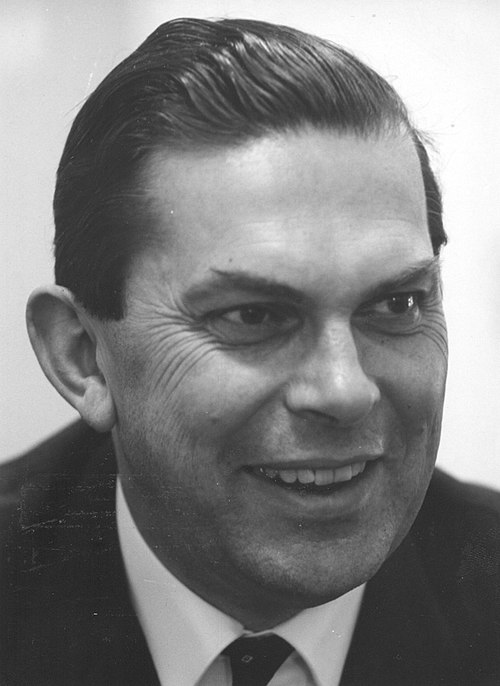
About Barend Biesheuvel
Barend Willem Biesheuvel (; 5 April 1920 – 29 April 2001) was a Dutch politician of the Anti-Revolutionary Party (ARP) and jurist who served as Prime Minister of the Netherlands from 6 July 1971 until 11 May 1973. Biesheuvel studied law at the Vrije Universiteit Amsterdam obtaining a Master of Laws degree and worked as a civil servant for the provincial executive of North Holland from September 1945 until January 1952 and as trade association executive for the Christian Farmers and Gardeners Association (CBTB) from January 1952 until July 1959 and as chairman from August 1956. Biesheuvel became a member of the House of Representatives shortly after the number of seats was raised from 100 to 150 seats following the 1956 general election, taking office on 6 November 1956. He served as a frontbencher and spokesperson for agriculture, local government affairs and Kingdom relations. Biesheuvel was also selected as a Member of the European Parliament, taking office on 7 March 1961. After party leader Sieuwert Bruins Slot announced his retirement Biesheuvel served as one of the lead candidates for the 1963 general election, and following the election, he was selected as party leader and parliamentary leader on 5 June 1963. Following a cabinet formation, Biesheuvel was appointed as Deputy Prime Minister and Minister of Agriculture and Fisheries with the responsibility for Suriname and Netherlands Antilles Affairs in the Marijnen cabinet taking office on 24 July 1963. The cabinet fell on 27 February 1965 and was replaced by the Cals cabinet, with Biesheuvel continuing his offices. This cabinet in turn fell on 14 October 1966 and was replaced by the caretaker Zijlstra cabinet, with Biesheuvel again retaining his functions. For the 1967 general election Biesheuvel served as lead candidate, but following a difficult cabinet formation failed to achieve a coalition and returned to the House of Representatives as parliamentary leader taking office on 23 February 1967. For the 1971 general election, Biesheuvel again served as lead candidate, and after a successful cabinet formation formed the Biesheuvel I cabinet, becoming Prime Minister of the Netherlands on 6 July 1971. The first Biesheuvel cabinet fell on 19 July 1972 just a year into its term and was replaced by the caretaker Biesheuvel II cabinet, with Biesheuvel continuing as Prime Minister. For the 1972 general election, Biesheuvel served once again as lead candidate, but the following cabinet formation resulted in a coalition led by Joop den Uyl, Leader of the Labour Party. Biesheuvel left office upon the installation of the Den Uyl cabinet on 11 May 1973 and announced his retirement, stepping down as party leader on 15 May 1973. Biesheuvel retired from active politics at just 53 and became active in the private and public sectors as a corporate and non-profit director and served on several state commissions and councils on behalf of the government, and continued to be active as a lobbyist for the European Union advocating for more European integration. Biesheuvel was known for his abilities as skilful manager and effective Debater. During his premiership, his cabinets were responsible for several major public sector reforms by stimulating further deregulation and endorsing more privatization. Biesheuvel continued to comment on political affairs as a statesman until his death at the age of 81 from cardiovascular disease. He holds the distinction as leading the last cabinet in which the prime minister was not from the largest party in the coalition, and his premiership is consistently considered both by scholars and the public to have been below average. In 1952 Biesheuvel became general secretary of the Christian Farmers and Gardeners Association of the Netherlands (CBTB) and in 1959 chairman of that organisation.
Biography source: Wikipedia. The profile adds birthday-specific historical context from the Celebs Birthday Today editorial database.