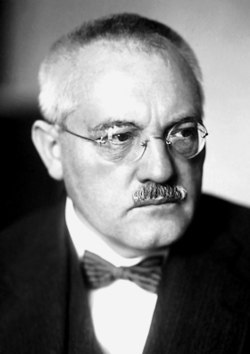
About Carl Bosch
Carl Bosch (German pronunciation: [kaʁl ˈbɔʃ]; 27 August 1874 – 26 April 1940) was a German chemist and engineer and Nobel Laureate in Chemistry. He was a pioneer in the field of high-pressure industrial chemistry and founder of IG Farben, at one point the world's largest chemical company. He also developed the Haber–Bosch process, important for the large-scale synthesis of fertilizers and explosives. It is estimated that one-third of annual global food production uses ammonia from the Haber–Bosch process, and that this supports nearly half of the world's population. In addition, he co-developed the so-called Bosch-Meiser process for the industrial production of urea. == Biography == === Early years === Carl Bosch was born in Cologne to a successful gas and plumbing supplier. His father was Carl Friedrich Alexander Bosch (1843–1904) and his uncle was Robert Bosch, who pioneered the development of the spark plug and founded the multinational company Bosch. Carl, trying to decide between a career in metallurgy or chemistry, studied at the Königlich Technische Hochschule in Charlottenburg (now Technische Universität Berlin) and the University of Leipzig from 1892 to 1898. === Career === Carl Bosch attended the University of Leipzig, and this is where he studied under Johannes Wislicenus, and he obtained his doctorate in 1898 for research in organic chemistry. After he left in 1899 he took an entry-level job at BASF, then Germany's largest chemical and dye firm.
Biography source: Wikipedia. The profile adds birthday-specific historical context from the Celebs Birthday Today editorial database.