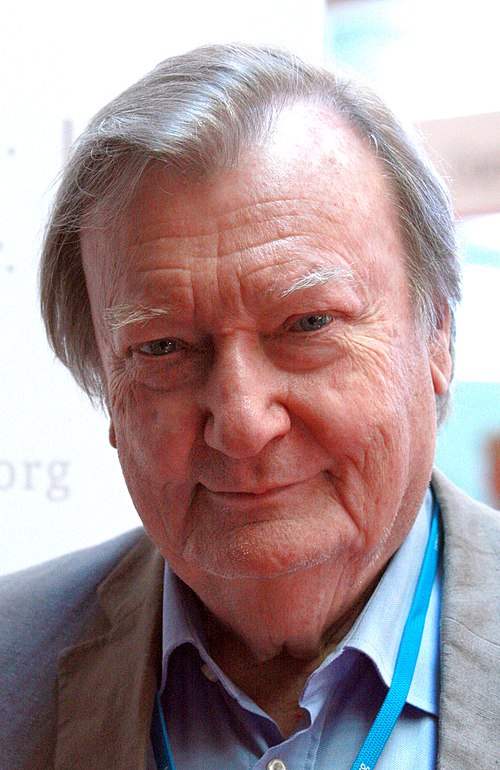
Portrait of Carlo Rubbia

Birthday profile

Carlo Rubbia

Carlo Rubbia, Italian physicist and academic, Nobel Prize laureate

Born
March 31, 1934
Age in 2026
92
Zodiac sign
Aries
Birth year
1934

About Carlo Rubbia

Carlo Rubbia (born 31 March 1934) is an Italian particle physicist and inventor who shared the Nobel Prize in Physics in 1984 with Simon van der Meer for work leading to the discovery of the W and Z particles at CERN. == Early life and education == Rubbia was born in 1934 in Gorizia, an Italian town on the border with Slovenia. His family moved to Venice then Udine because of wartime disruption. His father was an electrical engineer and encouraged him to study the same, though he stated his wish to study physics. In the local countryside, he collected and experimented with abandoned military communications equipment. After taking an entrance exam for the Scuola Normale Superiore di Pisa to study physics, he failed to get into the required top ten (coming eleventh), so began an engineering course in Milan in 1953. Soon after, a Pisa student dropped out, presenting Rubbia with his opportunity. He gained a degree and doctorate in a relatively short time with a thesis on cosmic ray experimentation; his adviser was Marcello Conversi. At Pisa, he met his future wife, Marisa, also a physics student. == Career and research == === Columbia University === Following his degree, Rubbia went to the United States to do postdoctoral research, where he spent about one and a half years at Columbia University performing experiments on the decay and the nuclear capture of muons. This was the first of a long series of experiments that Rubbia has performed in the field of weak interactions and which culminated in the Nobel Prize-winning work at CERN. === CERN === He moved back to Europe for a placement at the University of Rome before joining the newly founded CERN in 1960, where he worked on experiments on the structure of weak interactions.

Biography source: Wikipedia. The profile adds birthday-specific historical context from the Celebs Birthday Today editorial database.

Career and life highlights

Carlo Rubbia timeline

  1. He moved back to Europe for a placement at the University of Rome before joining the newly founded CERN in 1960, where he worked on experiments on the structure of weak interactions.
  2. In 1984 Carlo Rubbia and Simon van der Meer were awarded the Nobel Prize "for their decisive contributions to the large project, which led to the discovery of the field particles W and Z, communicators of weak interaction".

The world when Carlo Rubbia was born

Carlo Rubbia was born in 1934. The year snapshot below places that birthday in its cultural and historical setting: the music and films people were following, the headlines shaping public life, and the everyday prices families encountered.

Culture in 1934

  • #1 song"Stars Fell on Alabama"
  • Top movieIt Happened One Night
  • Best-selling bookTender Is the Night – F. Scott Fitzgerald

Headlines and milestones

  • Major sports momentFirst Masters Tournament held at Augusta National
  • Top headlineFBI kills John Dillinger outside a Chicago theater
  • Technology milestoneFirst streamlined passenger train (Burlington Zephyr)
  • Defining fadShirley Temple mania
  • Notable inventionLaundromat
  • World population2.20 billion

United States snapshot

  • U.S. leaderFranklin D. Roosevelt
  • Sports championSt. Louis Cardinals (World Series)
  • U.S. population126.4M

1934 versus 2026

These figures put everyday life in Carlo Rubbia's birth year beside the site's latest United States snapshot.

Measure19342026
Gas$0.19$3.45/gal
Average home$4,900$435,000
Average income$2,500$67,500
Minimum wage$0.25$7.25/hr (federal)
Movie ticket$0.20$11.95
Postage stamp$0.03$0.73
Population126.4M341 million

Sources and editorial standards

This profile combines a biographical source with structured birthday and historical context. Sources recorded for this profile: Wikipedia, Encyclopaedia Britannica, Library of Congress. See our editorial policy for sourcing, corrections, and review standards.

Read the source biography on Wikipedia. Wikipedia text is available under the Creative Commons Attribution-ShareAlike License.