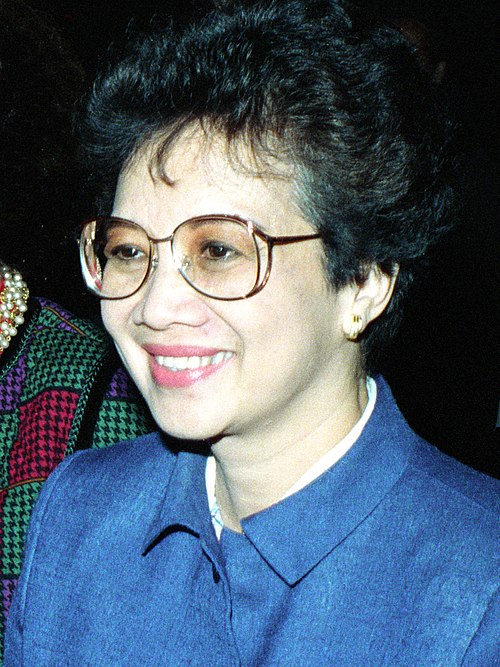
About Corazon Aquino
María Corazón "Cory" Sumulong Cojuangco-Aquino (Tagalog: [kɔɾaˈsɔn kɔˈhwaŋkɔ aˈkino]; January 25, 1933 – August 1, 2009) was a Filipino politician who served as the 11th president of the Philippines, serving from 1986 to 1992. The first female president in Philippine history, Aquino was the most prominent figure of the 1986 People Power Revolution, which ended the two-decade rule of President Ferdinand Marcos and led to the establishment of the current democratic Fifth Philippine Republic. She has been regarded by media outlets as the "Mother of Democracy". Aquino was married to Senator Benigno Aquino Jr., a prominent critic of President Marcos. The couple had five children, including 15th president Benigno Aquino III and entertainer Kris Aquino. After the assassination of her husband on August 21, 1983, she emerged as leader of the opposition against the president. In late 1985, Marcos called for a snap election, and Aquino ran for president with former Senator Salvador Laurel as her running mate for vice president. After the February 7, 1986, presidential election, the Batasang Pambansa proclaimed Marcos and his running mate Arturo Tolentino as the winners, which prompted allegations of electoral fraud and Aquino's call for massive civil disobedience actions. Subsequently, the People Power Revolution, a non-violent mass demonstration movement, took place from February 22 to 25. With support from the Philippine Catholic Church and defections from the Armed Forces of the Philippines, the People Power Revolution ousted Marcos, and Aquino, with no prior political experience, was sworn in to the presidency on February 25, 1986. As president, Aquino spearheaded the development of the 1987 Constitution, which limited the powers of the presidency and re-established the bicameral Congress, removing the previous dictatorial government structure. The constitution also affirmed social justice and equality as guiding principles of national development, reinforcing efforts to promote civil liberties, democratic participation, and social cohesion following the end of authoritarian rule. Her economic policies focused on forging good economic standing amongst the international community as well as disestablishing Marcos-era crony capitalist monopolies, emphasizing the free market and responsible economy. Her administration pursued peace talks to resolve the Moro conflict, and the result of these talks was creation of the Autonomous Region in Muslim Mindanao. Aquino was criticized for the Mendiola Massacre, which resulted in the shooting deaths of at least 12 peaceful protesters by Philippine state security forces. The Philippines faced various natural calamities in the latter part of Aquino's administration, such as the 1990 Luzon earthquake, 1991 Mt. Pinatubo eruption and Tropical Storm Thelma. Several coup attempts were made against her government. She left office in 1992 and remained active in political activities. Aquino was diagnosed with colorectal cancer in 2008 and died the following year. Her funeral was the subject of global media coverage, and monuments and public landmarks in the country were named in her honor. Corazon Aquino campaigned on behalf of her husband and delivered a political speech for the first time in her life during this political campaign. Ninoy Aquino, a former Nacionalista turned Liberal, rose to become the youngest governor in the country in 1961 and then the youngest senator ever elected to the Senate of the Philippines in 1967. Ninoy Aquino was among the first to be arrested at the onset of martial law, and was later sentenced to death. Despite Corazon's initial opposition, Ninoy decided to run in the 1978 Batasang Pambansa elections from his prison cell as party leader of the newly created LABAN.
Biography source: Wikipedia. The profile adds birthday-specific historical context from the Celebs Birthday Today editorial database.