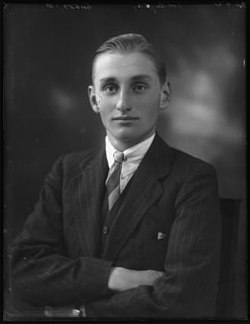
About David Cecil, 6th Marquess of Exeter
David George Brownlow Cecil, 6th Marquess of Exeter, KCMG, KStJ (9 February 1905 – 21 October 1981), styled Lord Burghley from birth until 1956 and also known as David Burghley, was an English athlete, sports official, peer, and Conservative Party politician. He won the gold medal in the 400 m hurdles at the 1928 Summer Olympics. == Early life == Born near Stamford, Lincolnshire, as heir to the 5th Marquess of Exeter, Lord Burghley was educated at Institut Le Rosey in Switzerland, Ludgrove School, Eton College and Magdalene College, Cambridge. At Cambridge, he was president of the Cambridge University Athletics Club and a member of the Pitt Club. == Athlete == A notable runner at school and at Cambridge, he continued with his athletics and won the British AAA championships in 120 yd from 1929 to 1931 and the 440 yd (400 m) hurdles from 1926 to 1928, and again in 1930 and 1932. Burghley made his Olympic debut in Paris in 1924, when he was eliminated in the first round of the 110 metre hurdles event. At the 1928 Summer Olympics, Burghley was eliminated in the semifinal of the 110 metre hurdles competition, but won the 400 metres hurdles, beating second and third placed Americans Frank Cuhel and Morgan Taylor by 0.2 seconds. At the first Commonwealth Games in 1930, Burghley won both hurdling events and was also a member of the gold medal winning British 4 × 440 yards relay team. In 1927–1930 Burghley also set several British records, one of which, 24.7 s in the 220 yard hurdles, set in 1927, stood until 1950. In 1931 Burghley was elected as Member of Parliament (MP) for Peterborough.
Biography source: Wikipedia. The profile adds birthday-specific historical context from the Celebs Birthday Today editorial database.